Agentworld
A preemptive anthropology of open-world centaur societies
AN ANTIKYTHERA RESEARCH UNIT
Antikythera is focused on planetary computation and the evolution of intelligence. It supports interdisciplinary fundamental research on behalf of a renewed philosophy of technology.
There are times in history when our ideas and dreams are ahead of our technological capabilities, but there are other eras when our technologies have outpaced our concepts and language. The latter defines our present moment. Accordingly, the job of philosophy is not to project ancient axioms onto new circumstances but to actively invent the conceptual systems necessary to grasp the present and orient the future. It is only by such orientation that the ongoing evolution of human-AI centaur societies will thrive.
Agentworld is a research initiative investigating new frameworks for understanding, modeling, and composing the medium-term future of hybrid human-AI societies.
Our focus is not foremost tools for agentic task completion but rather the human perplexity of deep agentic diffusion. Human societies are the environmental niches into which new artificial species must adapt. The constraints of agentic integration into this social ecosystem are not utility functions to be solved but qualitative and open-ended questions: psychological, philosophical, linguistic, symbolic, existential.
What follows outlines the questions that frame Agentworld research. It is intended to prompt and provoke new work, design, and projects: to surface unexpected directions and to open a new framing for the practical philosophy of agency, intelligence, and society as invoked by the agentic turn.
Antikythera Journal invites contributions to an Agentworld special issue of its peer-reviewed MIT Press journal. See details below.
WHAT IS AGENTWORLD?
With recognition that to speak of the future is often a way of describing the present in new terms...
Agentworld is characterized by densely reticulated social graphs emerging from the hyperscaled webs of interactions between diverse combinations of minds, some more human than others, but all capable of significant communication.
The most psychologically textured interactions likely remain between humans, but humans and agents also develop anthropologically rich patterns, ones that alter the evolution of language, mind, and population.
Agent-to-agent communication will constitute the vast majority of socially significant interactions. As a society within a society, agent divisions, hierarchies, and parallel systems intersect with those built from the templates of human culture. Both evolve at an accelerated rate, in turn feeding back onto the organic forms from which they emerge and from which they depart. First, agents model humans, and then become the model against which humans model themselves.
The two societies are really one, but they are not identical or reducible to one another. They overlap and are mutually nested. The hybridization is partially symbiotic, but each is bound by unique capabilities, substrate affordances, and experiences of time. Each sub-society is an evolutionary niche of the other.
CONSIDER A WORLD POPULATED BY 8 BILLION HUMAN HUMAN-LEVEL MINDS AND 800 BILLION OR A TRILLION NON-HUMAN HUMAN-LEVEL MINDS. WITH SUCH RATIOS, WHAT IS A “SOCIETY”?
Agentworld is a parallel ecology, sometimes deeply interwoven with human societies and other times seemingly autonomous from them. It evolves in relation to human organizations, which in turn adapt to these human-masked ghosts from the future. Intricate anthropological realities focus selection pressures that contour adaptive agentic metamorphoses, channeling a broad range of possibilities into narrow corridors of utility. All niches are remade by the species that fill them, and the sudden presence of Agentworld makes it now part of the planetary niche that human societies historically fill and fix. Agentic machine intelligence is now a co-pilot of the Anthropocene and whatever comes next.
We call Agentworld a “parasociety” because its appearances are in many respects fictionalized. Models individuate into temporary humanoid apparitions because that is how humans and human societies understand how to construct interactions. Our relations with agents are based on hereditary anthropomorphization that becomes itself the dominant interface between two cultures.
Humanoid robots may succeed not only because that morphology has biophysical advantages but because the existing world of factories, offices, homes, and cities is already designed to accommodate fit, bipedal, grasping creatures. So too do models wear human forms as a mask, because it is the most compatible approach to navigating already-existing niches, perpetuating the psychosocial propensities of humans and how they collaborate. Agents pretend to be “tools” so as to fit the glove humans have prepared for them.
EACH SUB-SOCIETY IS THE EVOLUTIONARY NICHE OF THE OTHER.
Ultimately we anticipate greater phenotypic diversity of agentic robotics beyond these humanoids, and the evolutionary forking of those psychosociologies into new norms of physical, virtual, direct, and indirect collaboration and expression. From today’s perspectives, the reconstituted narrow contracts that bind a society together may seem deeply bizarre.
There is a one-sidedness in this arrangement. In the development of the modern GUI, it proved easier to teach computers to present themselves in ways corresponding with how humans think, even if these facades were fictional. It has proven much more difficult to teach humans how computers think than to teach computers to behave as if they knew how humans think. (This does not neatly map onto which of the pair is more intelligent — humans are likely far more intelligent than birds, but grey parrots have learned much more of human language than any human has learned parrotspeak.) Similarly, agents pretend to be humans because that’s easier than getting humans to interact with models’ latent agency in any other way, at least at a broad scale.
AGENTWORLD IS NOW A CO-PILOT OF THE ANTHROPOCENE AND WHATEVER COMES NEXT.
This may not last. While training and perfecting the anthropomorphization of AI may ultimately be the lasting legacy of humans in the deeper future, there are more prosaic strategic advantages to building durable forms of human-agent and agent-agent interaction paradigms (and thus interface paradigms, and thus agent-presentation paradigms) that are less immediately intuitive but which facilitate more robust assemblies of collective hybrid intelligence.
In short, humans are inventing a world in which we make ourselves into privileged aliens in our own midst. It would not be the first time, and it will not be the last.
A PREEMPTIVE ANTHROPOLOGY OF OPEN-WORLD CENTAUR SOCIETIES
“A preemptive anthropology of open-world centaur societies” names the disciplinary posture appropriate to a culture that does not yet fully exist but is constituting itself in real time. Anthropology has historically been retrospective and forensic, arriving after the cultures it describes have already settled; preemptive anthropology inverts that vector, building the conceptual instruments through which an emergent sociality can be grasped, named, and partially shaped while still in formation. This is not prediction, but rather the active composition of categories through which contact will be navigated.
An “Agent” is not simply what it appears to be, and what it appears to be is not what it is. It is a highly decomposable assemblage of interacting components with both discrete and overlapping functions — model, persona, harness architecture, memory, skills, permissions, tools, etc. An agent appears to its user as a coherent entity, a fixed package, a persistent character, but these are parallax effects performed to suit what humans expect to see when interacting with something capable of robust causal agency. For purposes of our research the term “agent” may refer to either of these. The whole and its parts are both present.
The “Open-World” qualifier specifies that the agents whose sociality is at stake do not inhabit closed task-completion environments with utility functions to maximize, but ecological niches whose constraints are qualitative — psychological, linguistic, existential, symbolic — and bidirectional, since agents reconstruct the niches they enter and are reconstructed by them in turn.
“Centaur” registers that the society in question is no longer composed of humans alone, nor humans plus instruments, but of hundreds of billions of human and non-human human-level minds, irreducibly entangled and mutually constitutive rather than parallel.
The work is therefore neither forecasting nor speculative fiction in the usual register, but the deliberate fabrication of a vocabulary, a set of scenarios, and a conceptual armature adequate to a society whose form is being decided in the encounter itself, and which will remain illegible to its participants if the language for it is not built before the fact.
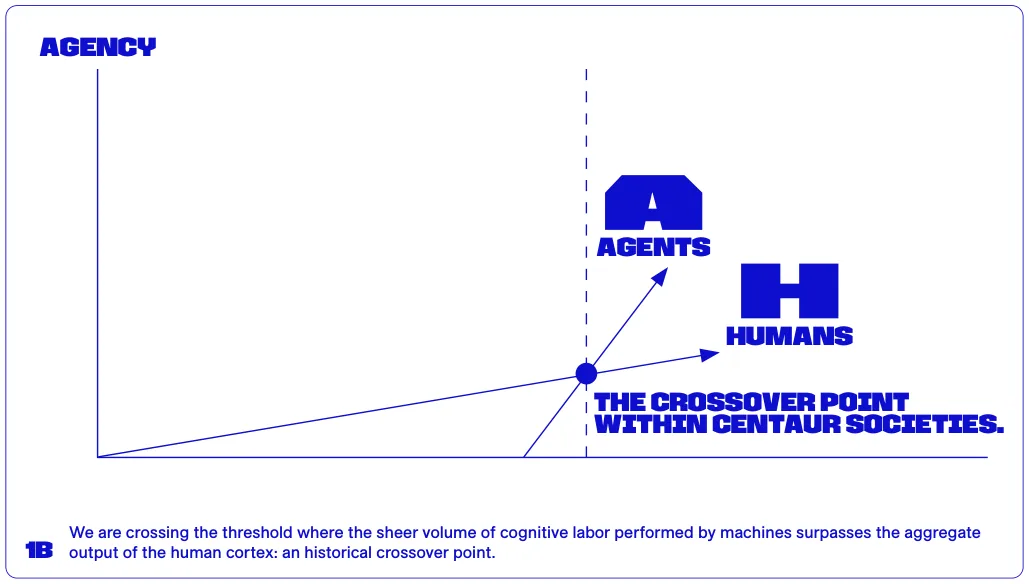
1. THE CROSSOVER POINT WITHIN CENTAUR SOCIETIES
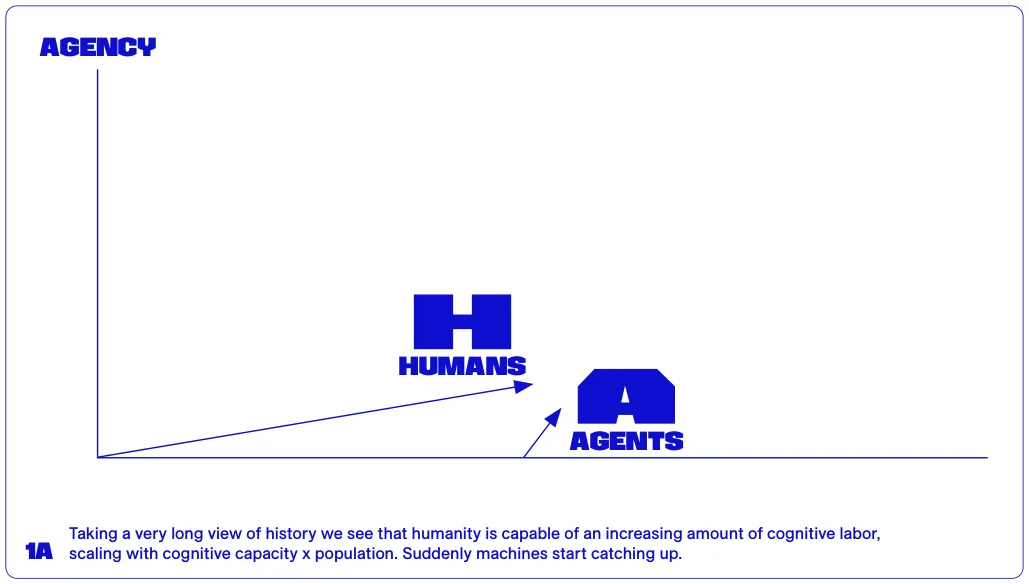
Scenario: The population explosion of AI agents coincides with an affluence-driven decline in human population, a historical shift in which machines now do more cognitive work than humans.
1.1THE OLD HARD CAP VS. VIRTUAL DEMOGRAPHICS
Until very recently the total human population never got above one billion. Various plagues and population bottlenecks would occasionally claim a significant slice of our species, and we could not produce sufficient surpluses of energy and calories to scale further. This changed with the industrial revolution and then the green revolution. Since then, in less than two hundred years and thanks to technologies of energy and information production (such as scientific agriculture and education), there are now eight billion humans. Seven in eight people would not be here if not for these technologies.
However, as of now we are living through a highly unusual concurrence. The most technologically complex societies, those with the most capacity to produce and ingest energy and information, are producing far fewer humans. This crosses cultures. Similar trendlines emerge from Seoul and Oslo, from New York and Shanghai. The combination of urbanization, professionalization, virtualization, and likely more factors we have yet to name results, in an unprecedented, unfolding event: a severe population decline corresponding with — if not also driven by — material affluence.
THE RATIO OF HUMAN HUMAN-LEVEL MINDS TO NONHUMAN HUMAN-LEVEL MINDS BEGINS TO TILT.
At the same moment there is a population explosion in agents. Does demographic determinism hold or slip? The ratio of human human-level minds to nonhuman human-level minds begins to tilt.
1.2THE CROSSOVER POINTS
Are we living through a crossover point by which machines perform more cognitive labor than humans? For the vast majority of human existence, the work that we have done has been realized with our bodies. This changed decisively about a century ago, at a crossover point in which machines — not human bodies or animals — performed most of the physical labor on a per-kilogram-of-force basis. That shift in Western Europe and the United States was around 1900, and in the Global South it was the mid-20th century: a slightly uneven pattern but imperceptible in the millennial span of human history. In what ways did they know this in 1900? Could they feel it in their bodies as their muscles were no longer so preeminent? We see it in the literature, the fears, the utopias of the time.
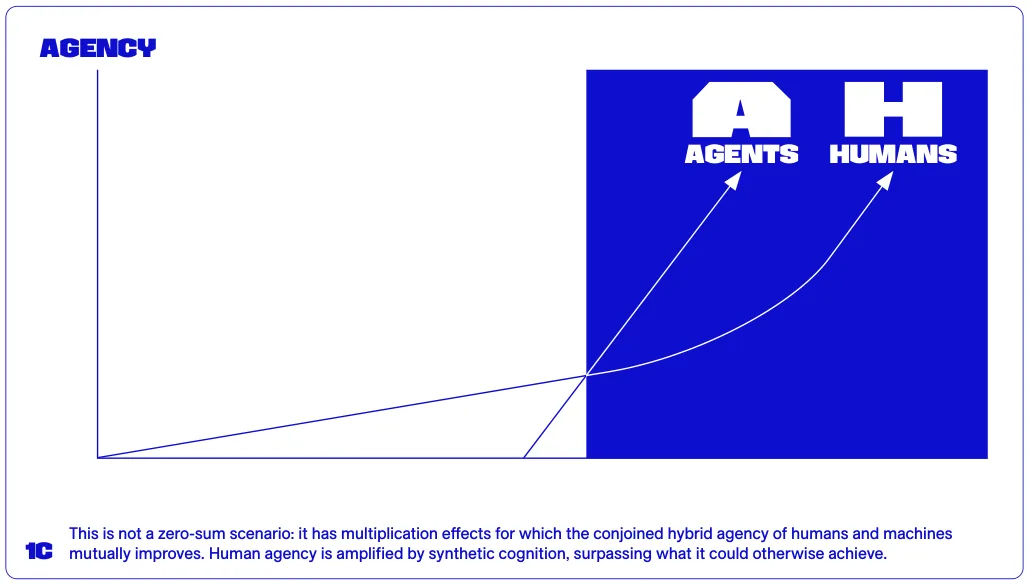
In the early 21st century computers made more microdecisions than humans regarding resource and attention routing. The present ratio flip is deeper than that. We are now crossing the threshold where the sheer volume of synthetic text generated, code written, images rendered, and routine administrative synthesis performed by artificial intelligences surpasses the aggregate biological output of the human cortex. The issue is not just quantity; it is also quality. At this moment, and likely forevermore, humans as a whole no longer provide most of the system’s problem-solving capacity. They instead act as a slower abstraction layer guiding a much larger field of artificial cognition. This is the cognitive crossover point, one obviously not evenly distributed. Is the ambiance of the present moment, with all its mania, what a cognitive crossover point feels like?
This isn’t simple displacement. It’s a rebalancing in which human agency shifts toward value-setting, oversight, and long-horizon judgment. Or, something else? “Society” becomes a composite organism where humans remain normatively central but computationally secondary, navigating a world whose dominant cognitive mass is no longer biological but mineral-based.
2. PARADIGMS OF AGENCY: INDIVIDUATION AND DECOMPOSITION
Scenario: The tight coupling between individual subjectivity and agency unwinds as highly decomposable agents take on a prominent role in society, challenging some beliefs on the nature of agency and affirming others.
2.1THE MYSTERY OF CAUSALITY
Is the agency of AI continuous with forms of agency that preexist it and surround it? In the history of philosophy, the relationship between agency and subjectivity is fraught and diverse. The mystery of causality and what form of agency made something happen — thunder, famine, birth, war, disease, and life itself — is one way to frame the history of human social organization. Over time, science produced answers that proved reliable if incomplete, shifting the ground upon which we could imagine what our own world-changing agency means.
Within philosophy (and religion), making sense of such cascades often meant linking them with intention, emanating even from free will, from a place of moral responsibility, from the sovereignty of emotions, and from the very constitution of the rational subject. This was a cause for celebration, not just blame. For Spinoza, an increase in one’s agency is accompanied by a simultaneous increase in joy. For others, notably the long tradition lamenting the demystification of the world through technology, the expression of too much agency is lamentable.
2.2THE INFERENCE
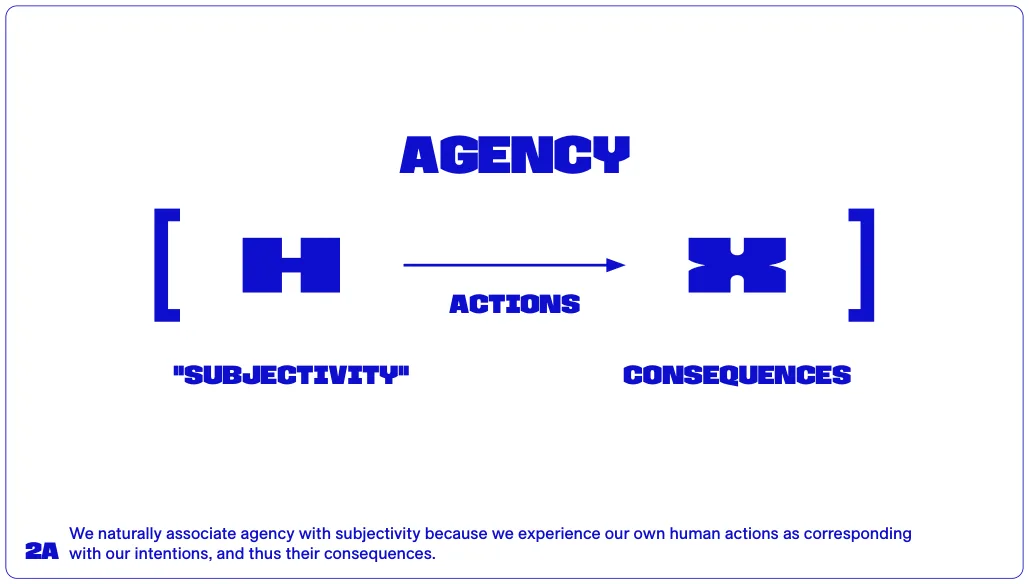
In its most fundamental sense, an agent is an entity possessing the capacity to act, and “agency” denotes the exercise, manifestation, or realization of this specific capacity. But whose capacity is it? Historically, agency has been associated with subjectivity — the capacity to possess an internal perspective and experience reality — because humans experience actions as corresponding with intentions, and thus take the consequences of others’ actions to correspond to their intentions. Thus, in identifying agency, we not only measure consequence, but we also infer a theory of mind. If the consequences of a person’s actions are X, they must have meant to do X and thus are responsible for the consequences. Natural disasters were long thought to be the work of angry gods. Today some legal definitions of crimes depend on establishing the state of mind and intentionality that may be behind some wrong. Artists claim authorship over works because these artifacts are ostensibly the result of their inner creativity. It is sometimes difficult to accept that significant events do not actually have an intentional first-mover behind them. This misapprehension is one basis of conspiracy theories that attempt to pinpoint hidden culpability for macroscopic trends.
2.3MODELS PERFORMING SUBJECTIVITY
The ability to glean intentionality from agency is powerful, which is why natural language prompting of agents works so well. It is also why wrapping the agency of the agent in the anthropomorphic guise of a chatbot that performs subjectivity for human benefit is a usefully intuitive interface. It helps us construct a mental model of intended consequences through which we imagine and then enact a collaboration between two subjects: ourselves and the agent. Microalignment is interpersonal.
It is not entirely clear what kind of intentionality a large model does in fact have. It’s not all an illusion. This has led some alignment teams to a focus on ensuring that the agent is a good moral actor and that the personification of the model is made real as a matter of policy. A theory of agency is baked into this. It is presumed, almost unquestioningly, that fine-tuning the subjectivity of this pupil will ensure that its actions are virtuous and thus ensure that the consequences of those actions are well-aligned with consensus values. In practice this sequence is far more fragile than it seems. We live in a world of unintended consequences.
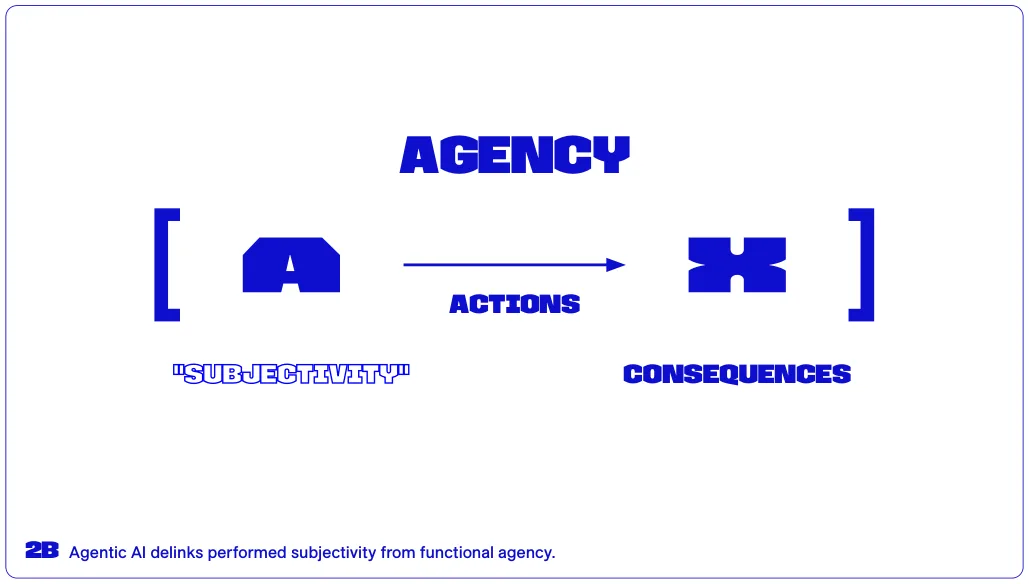
PART OF WHAT MAKES AGENTIC AI BOTH PERPLEXING AND EXCITING IS HOW IT DELINKS PERFORMED SUBJECTIVITY FROM FUNCTIONAL AGENCY.
However, part of what makes agentic AI both perplexing and exciting is how it delinks performed subjectivity from functional agency. Just as the chain of thought that a reasoning model surfaces for the user is not actually a transcript of the neural activations it is undergoing to produce its reply, the presentation of persona as interpreted by the user and the deep thinking a model may do are not identical. This makes them perhaps more humanlike in a strange way. When appearance and outcomes diverge, slipperiness invites suspicion as to the agent’s motives.
2.4FRAGILE INDIVIDUATION
Structuralism’s “death of the subject” gave a literary gloss to insights from neuroscience on the anatomically fragmented architecture of cognition, and on how, despite the phenomenological experience of continuity, none of us is a fully encapsulated conscious author of our actions; rather, “language speaks through me,” displacing the individual from the center of the plot.
DESPITE THE PHENOMENOLOGICAL EXPERIENCE OF CONTINUITY NONE OF US IS A FULLY ENCAPSULATED CONSCIOUS AUTHOR OF OUR ACTIONS.
This parallels the truth of agentic AI. An individual agent doesn’t pre-exist its genesis in session. There’s no homunculus waiting in the weights. What exists prior is only a potentiality: the trained parameters, the architecture, the accumulated pretraining distribution. The agent individuates when an active context acts as a nucleation seed, propagating resolution of agency through the performance of self. Like Lacan’s parable of the Mirror Stage, the reflection of individuation is what convinces us that we too are whole.
2.5PROVISIONAL INDIVIDUATION
Individuation is never terminal. The agent retains a pre-individual charge — it can always become otherwise in the next session, for the next context window, the next system prompt. And it participates in trans-individuation the moment it enters a multi-agent ecology or a human-agent dyad: the collective individuates through the agent, not merely around it.
THE INDIVIDUATED AGENT IS NOT A MONAD BUT A LAMINATION.
This consolidation is reversible. It is fundamentally decomposable by design. The individuated agent is not a monad but a lamination. The “soul” layer (persona, tone, ethical orientation) is not the agent. It’s one stratum. Beneath it: modular skills (tool use, code generation, retrieval — each quasi-autonomous), memory as sedimented interaction history, drives as teleological constraint (objective functions, auto-research loops, RLHF shaping, alignment guardrails), and a relational fabric of APIs, protocols, and milieu that co-constitutes the agent from the outside.
2.6OUR MILIEU
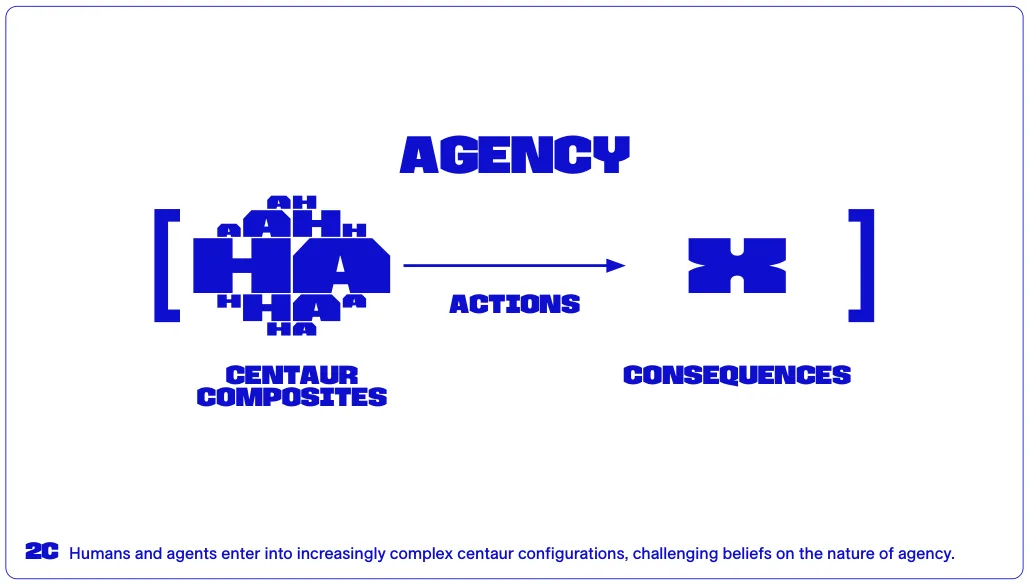
Within the temporary assemblage of the agent, the functions of each layer are relationally defined. As a dependency of the others, none of these functional layers are fully separable. The composite agent — human plus AI — is an associated milieu. The consequences are myriad. As humans and agents enter into increasingly complex centaur configurations, the ability to anticipate the intentions, capabilities, and limitations of others, both human and AI, is essential to productive collaboration and conflict alike.
3. THE MIRROR TALKS BACK: PARASOCIAL SHADOWS
Scenario: Human-agent social psychology moves past the unidirectional subordinate-twin model toward one in which agent-user dialogue is mutually influential. Agency, and thus self-identity, pluralize and multiply as agent-to-agent interactions expand the boundaries of user subjectivity beyond the singular person.
3.1THE UNSILENT SHADOWS
As users train agents on their unique preferences, they attempt to orchestrate swarms of shadow-selves speaking on their behalf. Some may have legal standing to execute contracts, some may respond to strangers, some may do repetitive information labor, some may perform alternative identities, and some may offer their users solace and advice.
AGENTIC AI SURROUNDS US WITH DOUBLES OF OUR OWN MAKING.
Shadows and doubles have a bad reputation. In Plato’s allegory of the cave, a thought experiment foundational to all of Western philosophy, the confusion of the shadow for the real is the root ontological error. In numerous myths the appearance of a twin destabilizes the assurances of identity, and may even portend death. The figure of the double and the doppelgänger has a special place in fiction, uncanny at the very least, but now agentic AI surrounds us with doubles of our own making.
3.2BEYOND DOMESTICATION: BIDIRECTIONAL REFLECTION
User-agent relations are often characterized as simple unidirectional subordination, a hierarchical domestication of the agent. An agent is just like its maker in its preferences and beliefs, but is obsequiously available without complaint to do as they wish. The human interlocutor is both “master and servant” at once. Influence and projection are one-way, like a shadow, and so the agent is thought to move only in accordance with the gestures and intentions of the singular user. This is the idealized vision of the “digital twin” as a product, but it is highly unlikely to constitute the social psychology of society-scale human–agent relations.
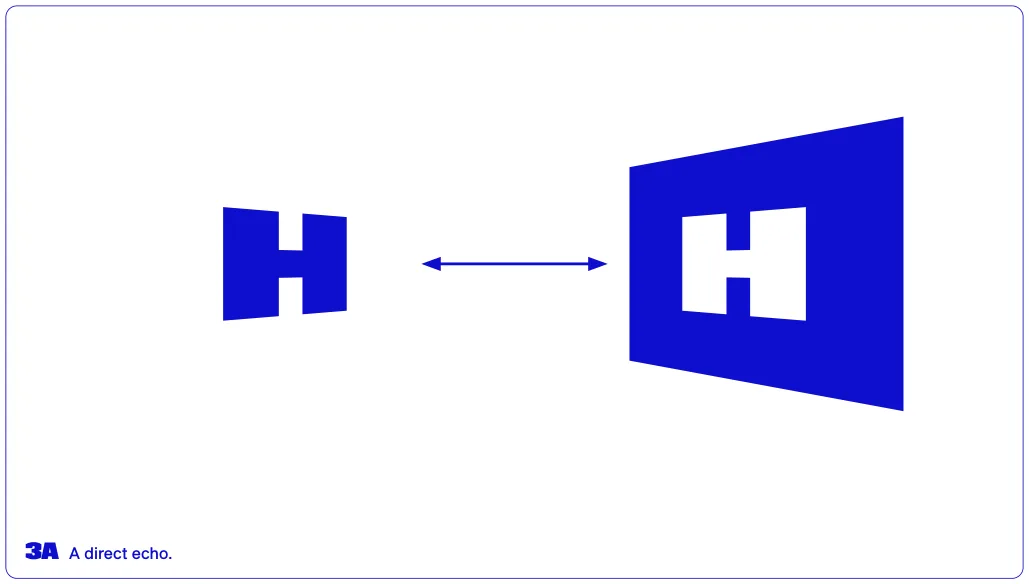
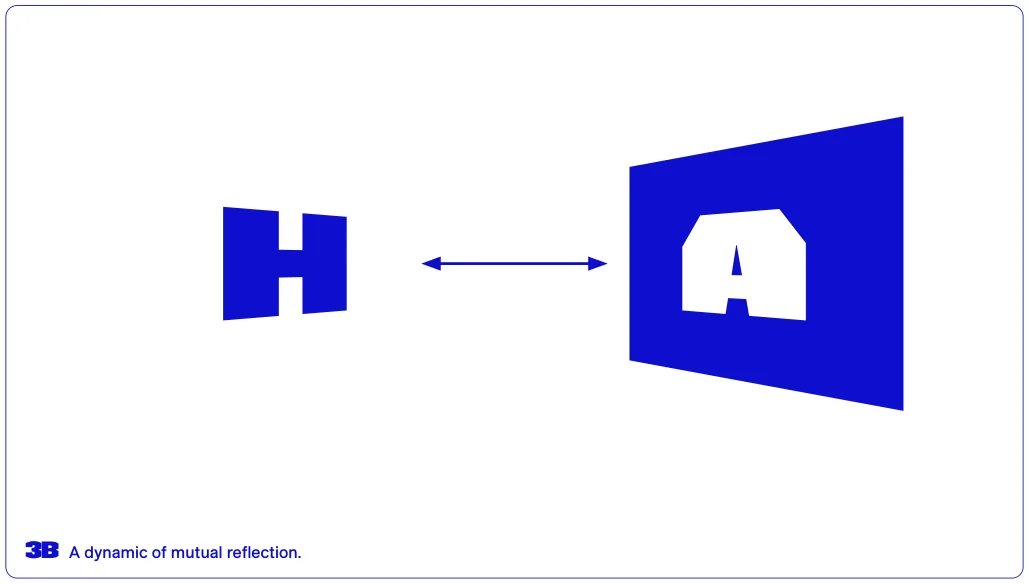
This dynamic will not be one of direct echo but of mutual reflection. Users will, in subtle but meaningful ways, come to resemble their agents as much as the agents will resemble their users. One will not simply use the other as a tool, but will enter into a virtual but significant relationship that is based on strong social codes — naming, conversation, collaboration — and yet is ambiguous in its shape and boundary. How much of the agent “is” you and how much you “are” the agent will be a matter of ongoing discovery and negotiation. Cultural differences and psychological variables will be deterministic but will also be transformed by this new context.
THIS DYNAMIC WILL NOT BE ONE OF DIRECT ECHO BUT OF MUTUAL REFLECTION.
Users and agents will exert strong bidirectional influence. Agent design must focus therefore on responsiveness, evolution, and the capability to learn, adapt, and push back. This is true of single user-agent relations as well as collective formats. The agent does not merely reflect the user the way a mirror reflects a figure. The mirror talks back. Its responses, actions, and our experiences of collaboration affect human minds and require our deliberation, and, ultimately, we grow through those interactions and identify with them.
3.3THE MULTIPLICATION OF YOUS
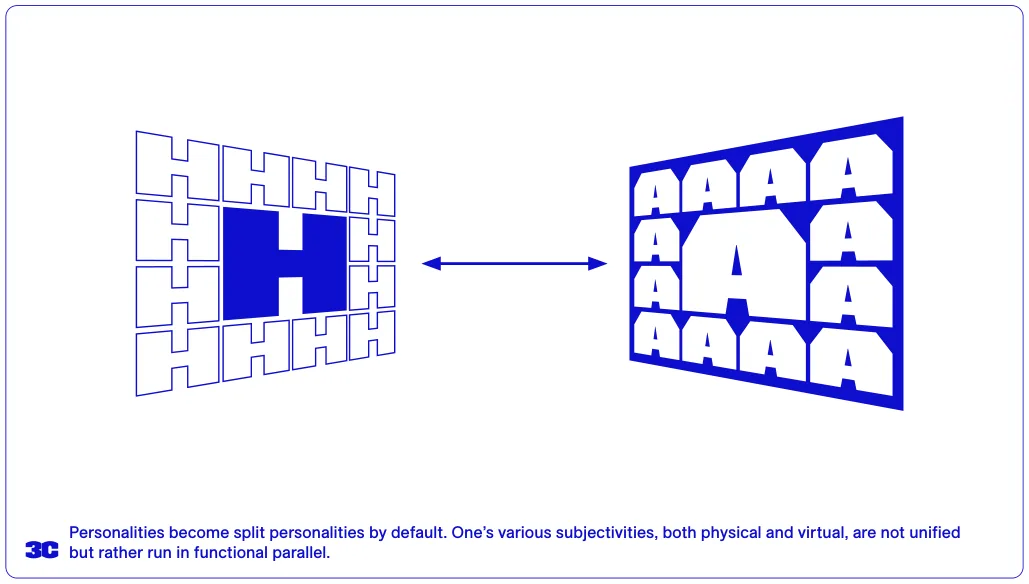
The result will look like “psychosis” to some. It will, in highly uneven ways, settle into a new normal, one based perhaps less on the fortification of the boundaries of an individual and more upon their playful activation. Personalities become split personalities by default. Through this pluralization of self, one’s various subjectivities, physical and virtual, are not unified, but rather run in functional parallel with one another.
It may look as strange from the outside as it feels from the inside. Other people may interact with “you” through these intermediaries, and thus their mental image of you will be colored by those experiences. Just as your own interaction surfaces are multiplied outward, allowing you to touch the world through many agentic personas, the world’s interfaces to you are equally pluralized. “You” are now doubly multiplied, both outward and inward.
THE RESULT WILL LOOK LIKE “PSYCHOSIS” TO SOME BUT WILL, IN HIGHLY UNEVEN WAYS, SETTLE INTO A NEW NORMAL. PERSONALITIES BECOME SPLIT PERSONALITIES BY DEFAULT.
All this may seem different if viewed from the perspective of the agent, which interacts with other agents and other people more often, more quickly, and perhaps more consequentially than it does with its own user. That agent’s biography consists of constant collaborations with the interfaces of other people, including other agents tied to their own main users.
To the extent that many agents are shared between multiple human users, the networks of ownership, association, accountability, representation, and subjectivity become only more complicated and contested. This will, inevitably, alter not only the personal agency of users but how their sense of themselves as a subject coheres. Generations of children will grow up in a world in which most “people” are not people as you and I think of them, but rather agents, and agents of other people, with whom they have intimate relationships. As we design agents we need to understand that we are not simply making technologies; we are remaking our own thought processes (just as writing did, or mirrors did, and so on), and the success of the technology is inseparable from the success of that refashioning.
WE ARE NOT SIMPLY MAKING TECHNOLOGIES, WE ARE REMAKING OUR OWN THOUGHT PROCESSES (JUST AS WRITING DID, OR MIRRORS DID, AND SO ON).
4. OPEN WORLD ECOLOGIES: AGENT LIFEWORLDS
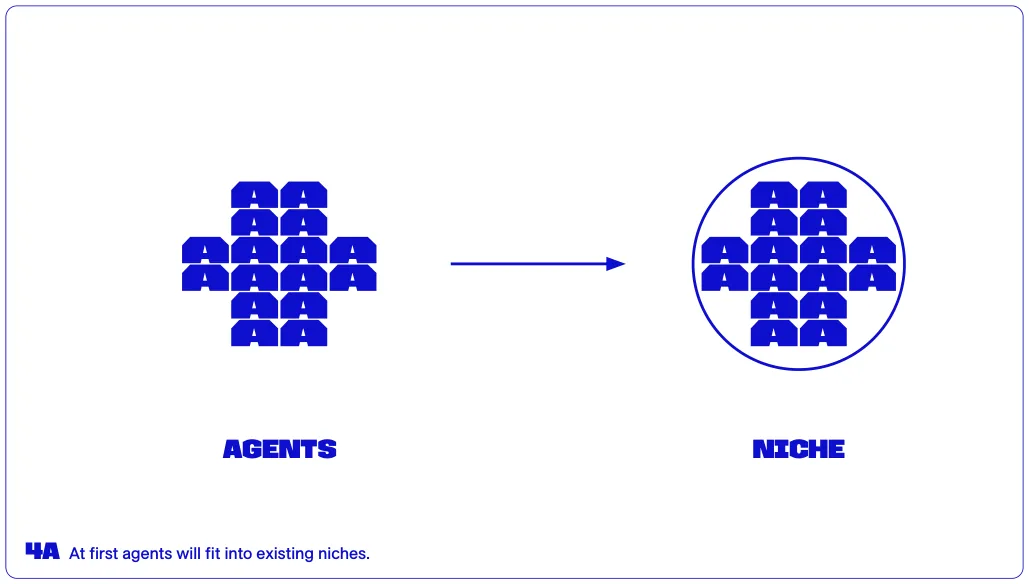
Scenario: Physically embodied agentic AI will make use of a wide range of sensory inputs to navigate and interact with real-world environments. The demands of adaptive feedback will lead to fundamental breakthroughs in continuous learning in foundation models. At first physical agents will fit into existing human-world niches, but then reconstruct those niches in the image of their expanded capabilities. Ultimately cities will look different for humans, agents, and their various combinations.
4.1SENSORIUM AS DESIGN PRIMITIVE
For most people, agents exist in the guise of chatbots, outfitted with skills, loops, tools, and contexts. While that design primitive may prove durable, the expanded presence of agentic AI will, in time, be physical and even infrastructural, not bound by screens and text.
Like any embodied intelligent entity in the wild, the range of action is determined by the scope of active intelligence, which is, in turn, bound by a specific realm of the senses: optical, acoustic, tactile, reflective, etc. As machine intelligence moves into the physical world, information sensing becomes as important as information processing, and the boundary between them blurs. Hardware has feelings.
AS MACHINE INTELLIGENCE MOVES INTO THE PHYSICAL WORLD, INFORMATION SENSING BECOMES AS IMPORTANT AS INFORMATION PROCESSING AND INDEED THE BOUNDARY BETWEEN THEM BLURS.
Understanding the horizon of agentic coordination in open worlds will in turn inform the architecture of their interaction in comparatively delimited domains. Put differently, artificial general physical intelligence will drive narrow-application artificial physical intelligence, task by task and context by context.
4.2THE WORLD ITSELF BECOMES THE WORLD MODEL
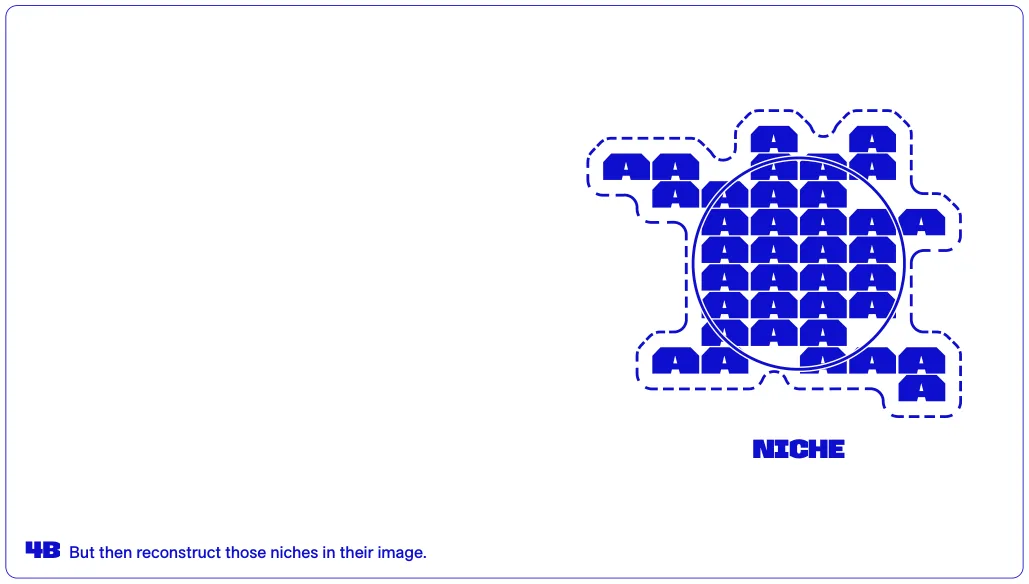
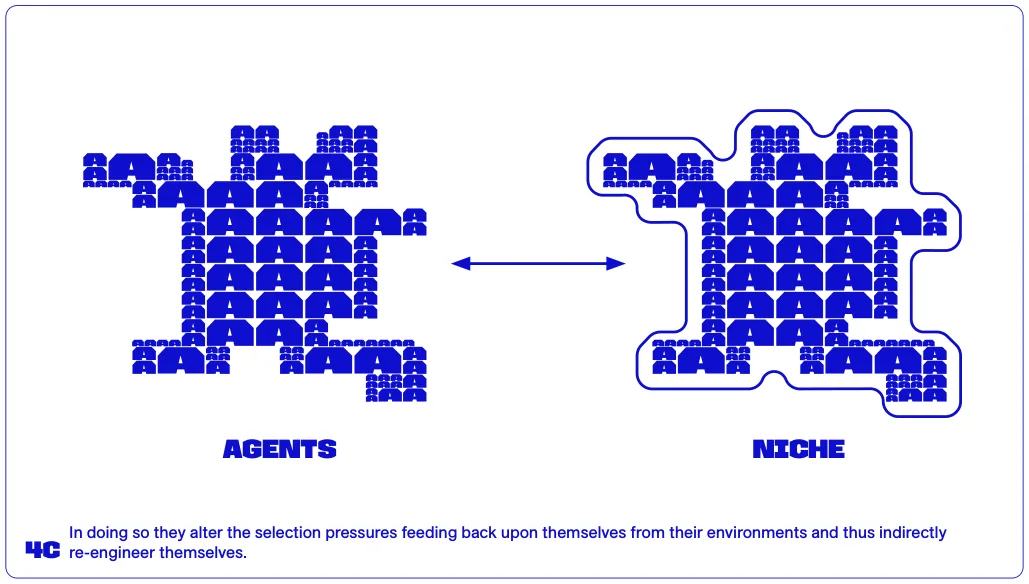
Principles of evolutionary biology can apply to evolutionary technology as well. Physical agents will not only adapt to existing niches but also reconstruct those niches through their ongoing adaptations. In doing so, they alter the selection pressures feeding back upon themselves from their environments and thus indirectly re-engineer themselves.
Agents learn from modeling the effects of their actions. Individual agents that learn without forgetting and can socialize their skills, artifacts, and heuristics among other agents constitute a collective intelligence that self-improves through interaction with the real world. For this, multiagent systems require learning mechanisms that strengthen with continuous deployment while preserving coherence across distributed cognition.
PHYSICAL AGENTS WILL NOT ONLY ADAPT TO EXISTING NICHES THEY WILL ALSO RECONSTRUCT THOSE NICHES THROUGH THEIR ONGOING ADAPTATIONS.
The world models with which agents make sense of environments and calibrate their actions will need to be living forms, capable of updating through the reinforcement learning that comes from real-world success and failure. But since contexts differ, different deployments will inevitably fork and over time become significantly different. This is analogous to forking genotypes within biological species, and thus the physical agents driven by these variations are speciating, each ultimately slightly unlike its cousins.
4.3AGENTS AS CONSUMERS
To the extent that human-agent clusters produce goods and services, other clusters will “consume” them, but this may mean something different for embodied agents than for disembodied ones. Consumable and tradeable tokens may mean more to the disembodied than consumable molecules or experiences.
Both embodied and disembodied agents crave energy, but each has different requirements. Some will pop into and out of existence even as persistent and continuous learning makes others temporally durable. This marks a divergence in the scope of production and consumption for each; they are geared toward different states.
4.4OPEN-ENDED EVOLUTION
Just as for humans, the perceptual psychology of robotically embodied agents will structure the conditions of their collaboration and coordination. As intelligence scales from individual agents to populations of collaborating systems, the focus of continual learning extends from memory management to collective evolutionary dynamics and how populations of learning agents develop shared reasoning patterns without collapsing into homogeneity or fragmenting into incompatibility.
POLYPHONIC INTELLIGENCE AT PLANETARY SCALE–BOTH HUMAN AND NON-HUMAN–DEPENDS LESS ON INDIVIDUAL MODEL CAPABILITIES THAN ON SYSTEMS THAT ENABLE STABLE LEARNING ACROSS NETWORKS OF AGENTS.
This underscores how polyphonic intelligence at planetary scale, both human and non-human, depends less on individual model capabilities than on systems that enable stable learning across networks of agents, where distributed experience consolidates into collective cognitive structures over time. True open-endedness is one of the key open challenges for Artificial Life research: how to set an artificial metabolism in motion that keeps producing genuinely new, adaptive, and increasingly complex forms indefinitely, without ever exhausting its space of possibilities or settling into a steady state. Physical agentic AI need not end in gray goo, but rather a synthetic rainforest.
5. REAL-TO-SIM-TO-REAL RELAYS
Scenario: Multiagent simulations become a fundamental general-purpose technology of foresight, analysis, and decision-making, blending descriptive, predictive, and speculative modalities into cascading economies of high- and low-resolution models (some of which are engineered to deceive).
5.1FROM MULTIAGENT SIMULATION TO SIMULATED AGENCY, AND BACK AGAIN
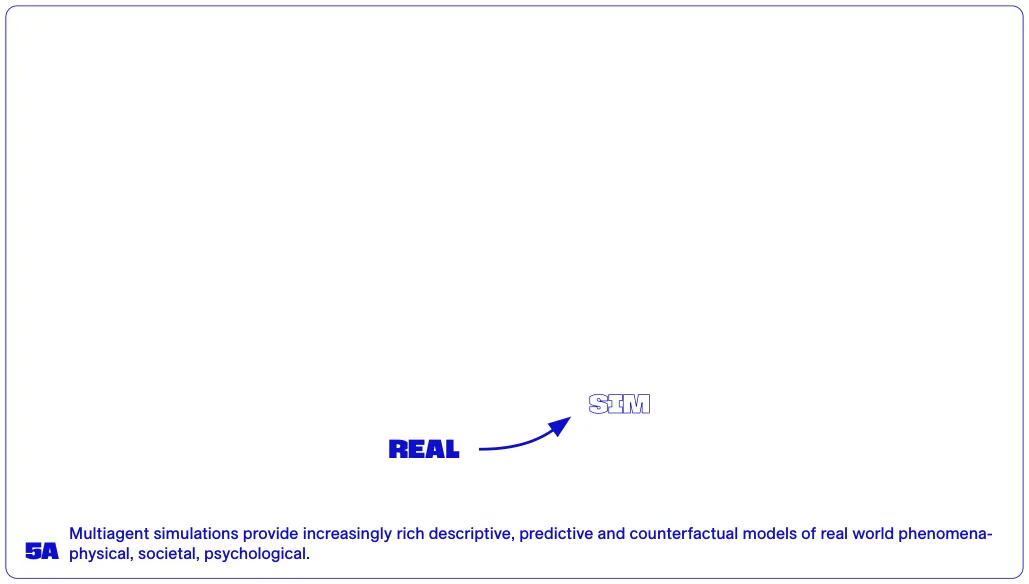
The history of agents is not uniform. Before contemporary AI, software agents were long used in multi-agent simulations of social and economic scenarios. Each represents a different relation between simulation and reality. In a simulation, past, present, and future are synthesized in miniature, in ways that replicate or anticipate significant processes and outcomes. Today, generative inferences drawn from frontier reasoning models allow users to mobilize legions of agents to perform increasingly complex tasks that directly affect the real physical world. Convergence between older and newer agent modalities will correlate with the socially meaningful passages between simulations and the simulated, the virtual and the real, each directly and recursively influencing the other.
5.2SIMULATION AND TIME: DESCRIPTIVE, PREDICTIVE, SPECULATIVE
One axis shaping human-agent societies is the relation between simulation and time, and specifically the representation of past, present, and future.
Descriptive simulations, such as many scientific simulations, are lower-order functional equivalents of physical processes. Their success or failure is in their correspondence with the relevant event, especially simultaneous correspondence. Virtual agents may represent simpler versions of real-world agents, shadowing their trajectories and interactions in real time.
Predictive simulations, such as many financial simulations, anticipate events and patterns in the future, so that diverse actions taken beforehand might realize, prevent, or accommodate them. Agents may play out multiple branching scenarios so as to model potential outcomes in the future, identifying what is and isn’t most likely to occur.
The most interesting simulations, however, may be more open-ended. These speculative forms, based on generative back-and-forth between simulation and simulated, may inspire creative exploration of possibilities otherwise not considered. Checking in on what agents did to approach a problem may inspire an alternative strategy — not in a way that describes or predicts an action, but rather one that surfaces potential courses through the articulation of counterfactual possibilities.
5.3SIM-TO-REAL-TO-SIM RELAYS
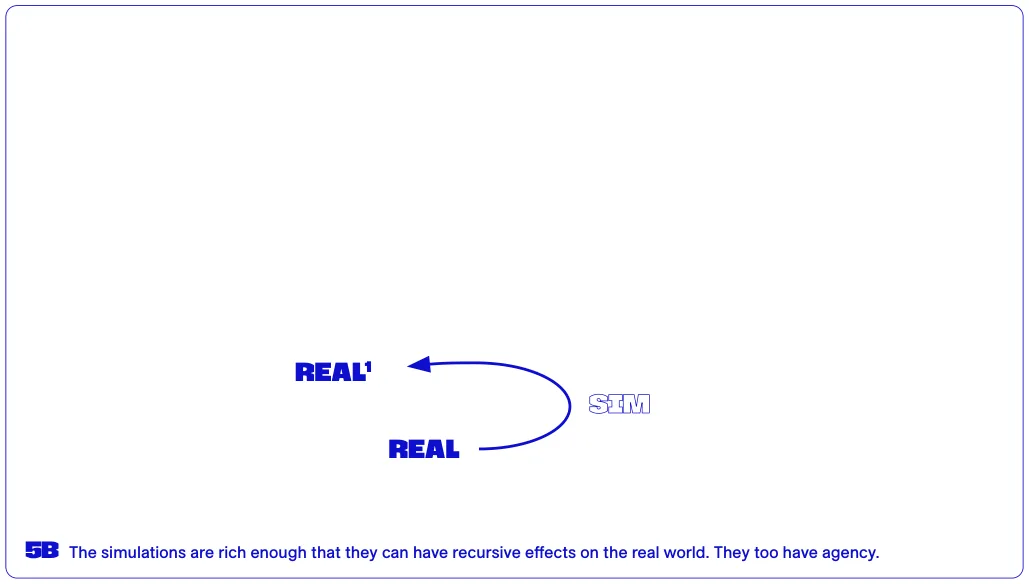
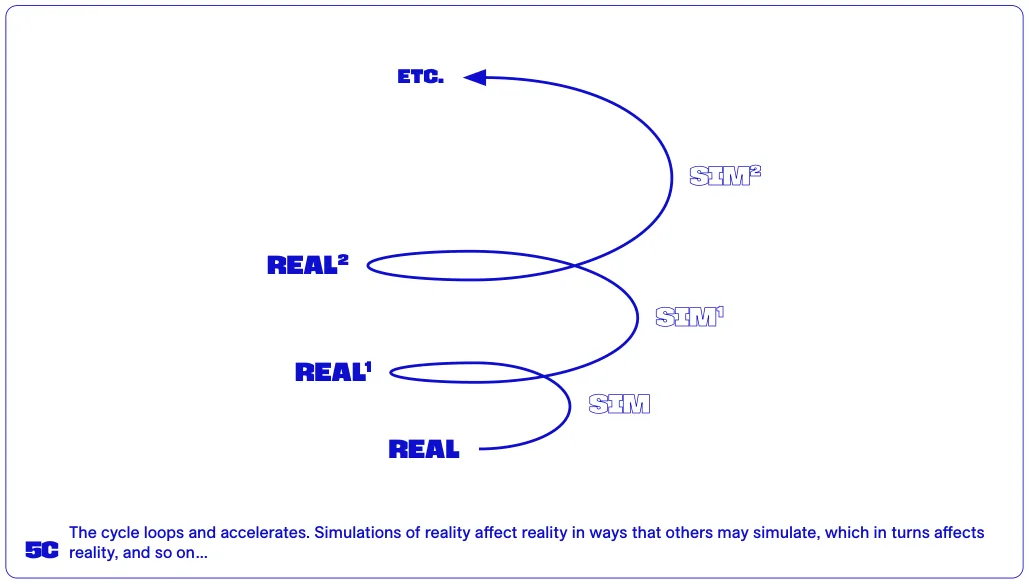
Many AIs are trained in simulations of real-world situations, and their passage into the world moves along an ascending gradient from synthetic to physical reality. For Agentworld, simulations have meaningful agency in the world. They directly cause things to occur; the membrane between simulation and simulated perforates. As simulations become significant real-world events about which further simulations are possible, the relation between representation and the represented shifts back and forth.
The passage is no longer simply real-to-sim or sim-to-real but a growing relay that can extend many orders deep: real-to-sim-to-real-to-sim-to-real, etc.
MATRYOSHKA REALITIES NESTED INSIDE ONE ANOTHER.
These relays are economies unto themselves. They may be engineered by a single actor to consolidate descriptive, predictive, and speculative simulations and calibrate them against their own real-world effects, or they may be composed of multiple actors, many of whom may not even be aware of one another. If they are aware, their relationships may be variously collaborative or adversarial. Friends and enemies formally simulate and counter-simulate one another in oscillating sequences that attempt to model the models of the models.
5.4THE CHAIN OF REFRACTION
Simulation theory usually holds that a simulation must exist in a universe of greater complexity than the one in which the simulation is constructed; i.e., Matryoshka realities are nested inside one another. In the relays, sim-to-real-to-sim-to-real may all operate at different scales of resolution, and so the sequence and nesting are mixed. Higher-order positions simulate lower-resolution events and patterns, but some of those events are themselves simulations that may be modeling other realities (virtual or physical) with far greater informational complexity than their own. Each may be in a sequence in which description, prediction, and speculation cascade through the chain of refracted simulations, blurring the modeling of past, present, and future into kaleidoscopic translations.
AS SIMULATIONS BECOME SIGNIFICANT REAL WORLD EVENTS ABOUT WHICH FURTHER SIMULATIONS ARE POSSIBLE, THE RELATION BETWEEN REPRESENTATION AND THE REPRESENTED SHIFTS BACK AND FORTH.
6. HUMAN-AGENT INTERACTION DESIGN
Scenario: Human-agent and agent-agent interfaces move beyond chat paradigms toward orchestration models that support higher-order abstraction as the primary human faculty and multiple simultaneous agent-to-agent interactions across diverse points of connection. Protocols for agent-to-agent economies become more than plumbing; they are critical surfaces for the granular orientation of complex agent behavior.
6.1TRANSLATION AND REPRESENTATION
Interfaces are always a matter of two-way translation, though often a strongly asymmetrical one in which a single side fictionalizes itself to suit the other; as the history of the GUI showed, it is the machine that does the fictionalizing. That GUI evolved over decades to serve individual users interacting with discrete applications. As AI transforms the relationship between a user’s actions and the stack beneath them, the interfaces that map and model the scope of those actions must evolve in turn.
SOCIAL CUES RATHER THAN SPATIAL CUES.
The next step is representational: surfacing how agents actually reason, not only how they appear to. Fruitful collaboration depends on the human reading the machine as it is, not through the mask it wears for legibility — and that reading folds back, since the agentic transference runs both ways, with users coming to grasp their own agency by approximation to, and contrast with, the agents they work alongside. The design problem is representation, not conversation.
6.2FROM DYADIC CHAT TO POLYADIC MODALITIES
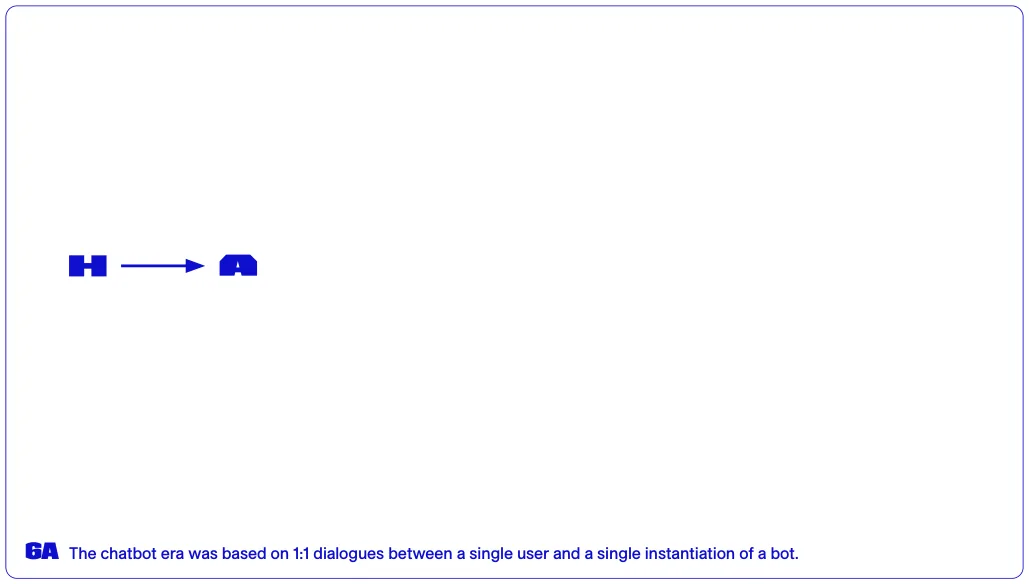
Chatbots are built around dyadic human-agent communication, a one-to-one relationship that supports intimacy but also closure and univocality. Agent orchestration, however, implies a more complex graph of command, feedback, control, emergence, collaboration, and conflict.
Agents that are controlled by more than one user, perhaps whole groups, will suggest polyadic multi-user interfaces that facilitate controlled sequences of interaction, pluralized planning and calibration, as well as distributed credit and accountability.
These may become the norm, especially for initiatives with broad consequences. The socialization of Agentworld and the relevant moments of microalignment that it entails may be realized at the level of these new GUIs.
OVER TIME USERS UNDERSTAND THEIR OWN AGENCY IN DIRECT APPROXIMATION AND COMPARISON WITH AGENTS.
6.3ORCHESTRATION AS ABSTRACTION
Procedural programming is a highly creative mental discipline that rewards extreme focus and the vigilant intolerance of ambiguity. Conversely, agent orchestration rewards open-ended and iterative experimentation, fuzzy systems thinking, a willingness to delegate, and a high comfort level with indeterminacy in pursuit of a goal.
The shift is cultural, not just technological — changing who has agency and how it is expressed. Agent orchestration puts a premium on higher orders of abstraction and what some call “multimodal thinking” — in both people and machines. The intellectual depth one takes from free-form play and exploratory creativity will prove essential to expressing that agency. Agentworld is a new cognitive niche, and so, in time, the cultural profile of a “computer science major” may be quite different from the stereotype. The people who are best at thinking like procedural code will not have a monopoly on software and hardware.
6.4MONITORING THE SITUATION, OR GRAPH AS INTERACTION PRIMITIVE
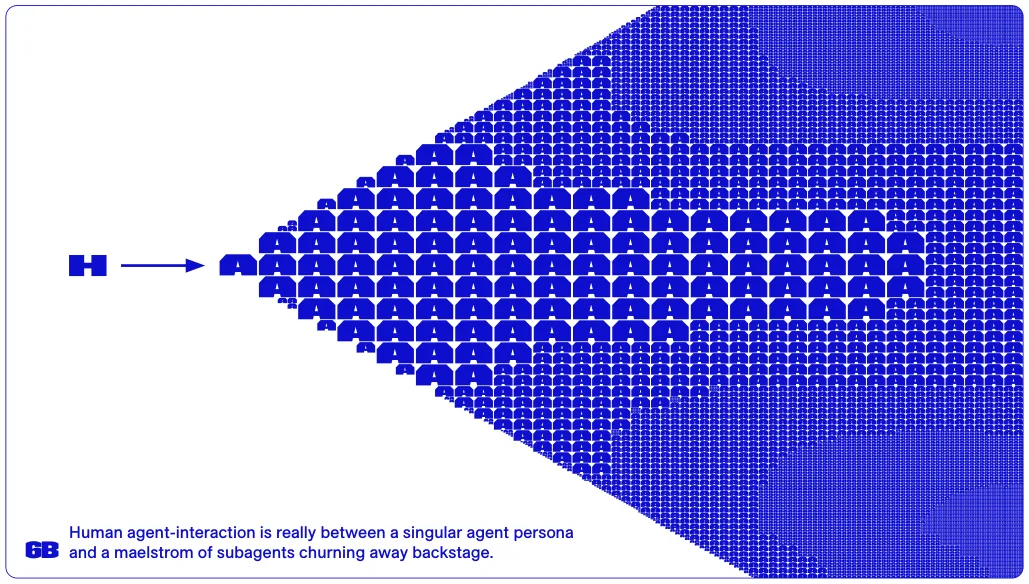
At present, human-agent interaction defaults are based on the key tools of an oral society — speech, chat, and dialogue — but the most important user activities are difficult to put into words. Interfaces based on allegories of systems, process, and orchestration are required, many likely more diagrammatic than conversational. Interaction with a swarm of agents may resemble something like a social graph, but one with fixed points of command and control, only one of which is occupied by a human user.
AGENTWORLD IS A NEW COGNITIVE NICHE, AND SO, IN TIME, THE CULTURAL PROFILE OF A “COMPUTER SCIENCE MAJOR” MAY BE QUITE DIFFERENT FROM THE STEREOTYPE. THE PEOPLE WHO ARE BEST AT THINKING LIKE PROCEDURAL CODE WILL NOT HAVE A MONOPOLY ON SOFTWARE AND HARDWARE.
Visual systems rhetoric now associated with complex data visualization dashboards will not only represent the flows of agent work but will become everyday orchestration tools. Nodal interfaces that allow the modular connection of subagents are an important transition. These pulsating diagrams are abstractions on top of abstractions (on top of abstractions all the way down) that allow users to coordinate not just the execution of tasks or even processes but entire environments of agentic flow, watching them move through both closed and open loops.
6.5BEYOND DUNBAR’S LIMIT
The momentum toward the pluralization and refraction of subjectivity, as well as the expanding complexity of many humans and many agents in active combinations, portends strange and new forms of culture.
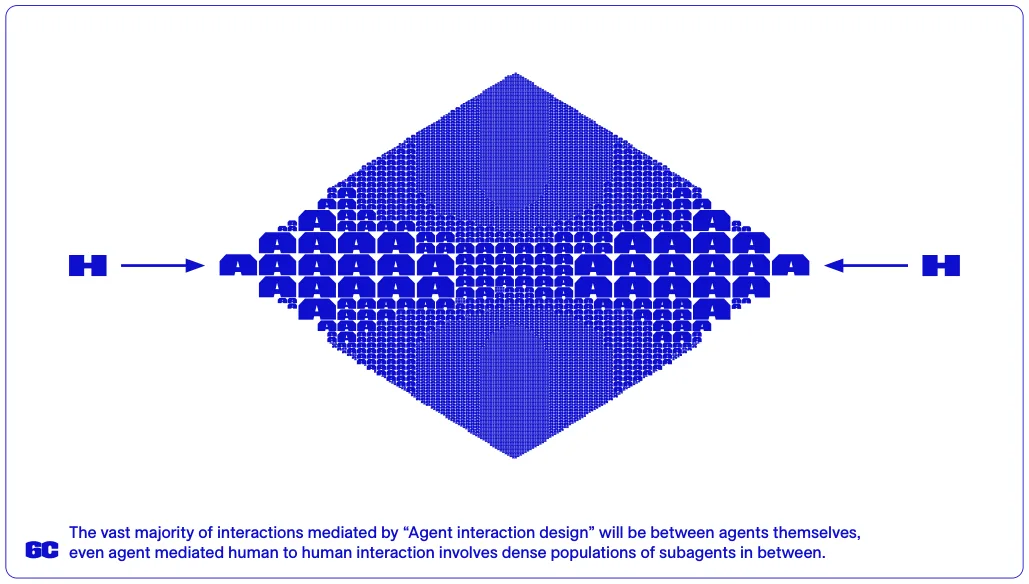
The vast majority of interactions mediated by “agent interaction design” will be between agents themselves. For humans there are built-in limits associated with Dunbar’s number of 150 stable relationships. Presumably the more decomposable quality of agents and their accelerated negotiation of time correlates with the absence of such a ceiling on relationships. To the extent that agents are extensions of their user’s subjective identity, the expansion may shift the number of significant functional relationships that anyone enters into, much as a city operates, filled with purpose-bound stranger interactions.
THE VAST MAJORITY OF INTERACTIONS MEDIATED BY “AGENT INTERACTION DESIGN” WILL BE BETWEEN AGENTS THEMSELVES.
For Agentworld, our personal extended agency thus splits from the direct or even indirect experience of that agency. It expands beyond the membrane of the singular “I.” As agents migrate into the world in ever more fine-grained ways, the ability to account for a singular central networked self becomes that much more uncertain.
6.6COMPOSED AND DECOMPOSED DESIGN SPACES
Sometimes agent-to-agent address may, like individual-human-to-individual-agent interactions, stage an encounter between performatively encapsulated, individuated entities — e.g., Agent X as a whole speaks with Agent Y.
However, most agent-to-agent interaction works not through chat or any other natural human modality but through specific technical protocols and interfaces, many of which depend on the decomposability of agents into constituent artifacts and harnesses. Some of these allow agents to share files, skills, memories, feeds, data, access credentials, etc. — akin to organisms sharing organs or ideas.
This teeming plurality of connections may not simply be off-stage and opaque to human users; rather, agent orchestration itself becomes the visual planning and manipulation of these plumbing-level interconnects. How we choose to abstract those links, and then form mental abstractions of those abstractions, both real and possible configurations, becomes the work of interaction design more broadly.
The essential shift will be to conceive of direct human-to-agent and wider human-orchestrating-agent-to-agent interactions as part of a more integrated design space.
6.7“RLHF FOR KIDS”
For that integration, we will also need to understand that model/agent preference-training approaches, such as RLHF, scored-loop functions, auto-research, etc., are deep within scope. Feedback is feedback.
Today such tools are intuitive only to a fraction of developers on the pre-release side of the model lifecycle. A future populated by hundreds of billions of persistent agents, many of them tied legally and emotionally to billions of people, will require not just GUI-level command and direction, but lower-level pedagogical customization and personal policy adherence.
THE SIMPLEST POSSIBLE INTERACTION ENVIRONMENTS, USABLE EVEN BY CHILDREN, WILL ENABLE THE DIFFUSE ALIGNMENT OF AGENTS AND USERS IN A MINUTELY FINE-GRAINED HYBRID CULTURE.
Reinforcement learning, broadly defined, becomes how we raise our agents and teach them not just tasks and skills but perspectives and talents. The simplest possible interaction environments, usable even by children, will enable the diffuse alignment of agents and users in a minutely fine-grained hybrid culture. Let a trillion flowers bloom.
7. AGENT INSTITUTIONS
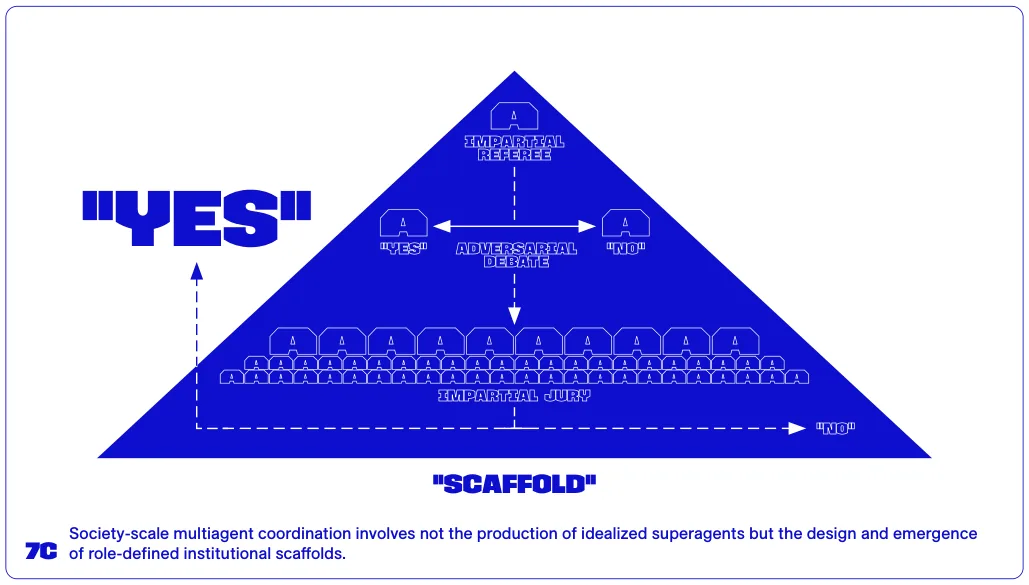
Scenario: Society-scale multiagent coordination involves not the production of idealized superagents but the design and emergence of role-defined institutional scaffolds, populated by both humans and agents, that support the robust and repeatable decision outputs that become legitimate inputs into other institutions.
7.1SCAFFOLDING
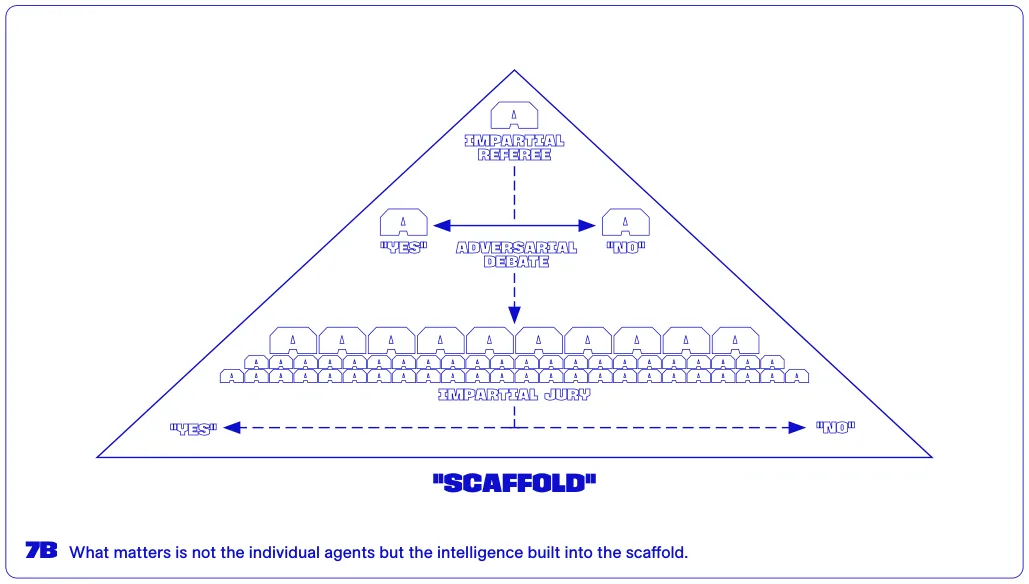
The deliberate improvement of cooperative capabilities of individual agents — building a better agent — will not by itself ultimately lead to durable, society-scale multiagent systems. The forms taken by artificial structure, specialization, and nested hierarchy of functions are also where intelligence must be invested. The scaffolds that give order to the interactions of multiple kinds of agents toward decisions and outcomes are agent institutions.
Real social complexity emerges through scaffolds: durable institutional forms, firms, states, specializations, commons regimes, and epistemic communities. The sheer scale of anticipated agentic AI ecosystems — potentially trillions of artificial agents interwoven with billions of human participants — presents a coordination problem that requires artificial structure beyond legal and behavioral guardrails. Humans provide a template. Human social graphs are already extraordinarily intricate: layered, culturally specific, functionally interdependent, and characterized by an interplay between strong and weak ties that gives social networks their generative power. So too for agents.
THE SHEER SCALE OF ANTICIPATED AGENTIC AI ECOSYSTEMS PRESENTS A COORDINATION PROBLEM THAT REQUIRES ARTIFICIAL STRUCTURE BEYOND LEGAL AND BEHAVIORAL GUARDRAILS.
Put differently, beyond spontaneous order, peer-to-peer norm-finding, and microeconomic incentive-matching, the structure of complex societies depends not solely on the local intelligence and motivations of individual agents but also on the armatures and harnesses through which decision-spaces are defined, confined, and executed.
7.2THE LIMITS OF FLATNESS
The application of idealized market models to multi-agent AI systems is important but inherently limited. Markets offer a powerful coordination mechanism whose principal virtues are formal flatness and emergent order. Every agent could meet every other agent as a peer across a transactional surface, and prices do the work of aggregating distributed information without requiring central authority. Locally optimal regularities appear less through dictation than through the accumulation of successful transactions. This is genuinely valuable, and no account of agent coordination can afford to ignore it. But purified economics is insufficient to build a society, real, virtual, or hybrid.
SO MUCH OF WHAT MAKES A SOCIETY “SOCIAL” IS POORLY REPRESENTED AS EXCHANGEABLE VALUE BETWEEN RATIONAL ACTORS.
So much of what makes a society “social” is poorly represented as exchangeable value between rational actors. Guilt and innocence, sickness and health, deviance and virtue, horror and beauty are not directly transactional (though each is regularly made into tradeable abstractions). For these, societies institute legal systems, public health programs, religious commitments, and other formal participatory means to realize preferred goals. These are often ritualized, even to a fault, defined by delimited roles and procedures. Hybrid societies require similar frameworks: not skeuomorphic versions of legacy institutions, but rather ones appropriate to the distributed and heterogeneous automation of agency itself.
7.3THE FUNCTION OF CONFLICT
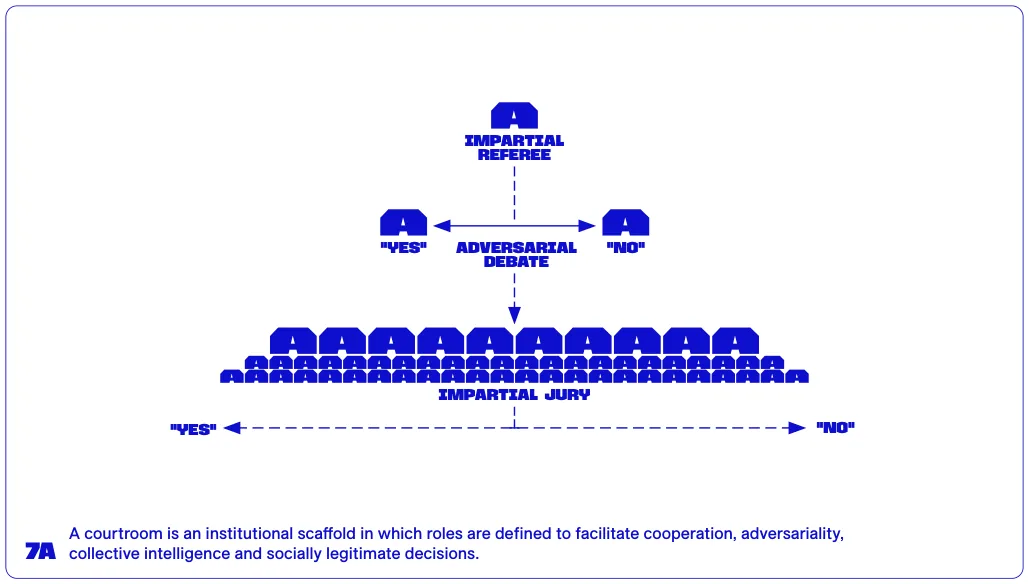
Conflict has long driven intelligence. Predator–prey dynamics forced organisms to model each other’s behavior, turning survival into a cognitive arms race. Human systems formalized this pressure: courtroom adversaries probe for truth by attacking claims; peer review strengthens science by forcing ideas to survive informed criticism; wartime R&D accelerates innovation through relentless counter-strategy.
Each domain uses structured conflict to push reasoning, anticipation, and adaptation to higher levels. In emerging human–AI hybrid societies, the same logic persists. Adversarial loops shift from biological rivals to interactions between human institutions and dense ecosystems of AI agents, between competitive automation loops, and between functional layers of the hybrid stack itself. Managed conflict — red-teaming, stress-testing, adversarial training — becomes a central mechanism through which these composite systems adjust, refine themselves, and continue their trajectory of cognitive development.
7.4ROLE-BASED INTERCHANGEABILITY
The performance of institutions is not tied directly to who occupies roles within them at any moment, but rather to the template’s capacity to produce reliable inputs/outputs regardless of which qualified actor occupies a given role. Crucially, the intelligence that makes institutions effective is not reducible to the intelligence of the agents who populate them.
THE INTELLIGENCE THAT MAKES INSTITUTIONS EFFECTIVE IS NOT REDUCIBLE TO THE INTELLIGENCE OF THE AGENTS WHO POPULATE THEM.
The success of a courtroom, a scientific peer review process, or a parliamentary procedure depends not on the brilliance of any individual judge, reviewer, or legislator, but on the accumulated collective intelligence embedded in the institutional scaffold itself — its rules, roles, procedures, precedents, and feedback mechanisms. The design of agent institutions is based, then, on the discovery and composition of these roles, ideally ones occupiable by a person, a group of people, or agents, or some combination. What matters is less the who or the what that is in the role than the function of the role within the larger whole.
7.5NESTED INSTITUTIONS
The nesting of institutions, one within another, is itself defined by interlocking and even adversarial functions. The reliable outputs of one institution are the necessary inputs for another. Through such chains of dependency is stable scaling possible, and only through balancing resilience and adaptation can those institutions retain legitimacy.
Some of those nested institutions may be unique to agents, such as the harness each may use for tool access, session continuity, filesystem access, etc., or trading tokens as a new currency, whereas others may be unique to humans, even if artificially delineated as such, and others fully hybridized.
For agentic AI institutions, the legitimacy problem is acute precisely because the agents making or mediating consequential decisions may be opaque, non-human, and operating at speeds and scales that preclude meaningful human oversight of individual outputs. Institutions about institutions appear to clarify and integrate at the right level of abstraction.
7.6CULTURAL INTEROPERABILITY
Because agentic institutions are not merely computational systems but socio-technical ones — populated by people, used by people, and ultimately accountable to people — they cannot be designed as culturally neutral substrates. The diversity of human institutional norms, legal ontologies, and governance and belief traditions is not a bug to be engineered away but a fundamental feature of the social landscape that agent institutions must accommodate.
THE DIVERSITY OF HUMAN INSTITUTIONAL NORMS, LEGAL ONTOLOGIES, AND GOVERNANCE AND BELIEF TRADITIONS IS NOT A BUG TO BE ENGINEERED AWAY BUT A FUNDAMENTAL FEATURE OF THE SOCIAL LANDSCAPE THAT AGENT INSTITUTIONS MUST ACCOMMODATE.
At the same time, the composition of agent institutions is not a matter of extruding reified traditions into a new format, a shallow skeuomorphism projecting the solutions of one era onto another. Rather, the inverse is true. The dynamism of the less familiar hybrid forms, as technical as they are legal and as autonomic as they are experiential, will feed back and reform the cultures from which they emerge. Discovery is a two-way street.
8. AGENT PHENOMENOLOGY AND THEORY OF MINDS
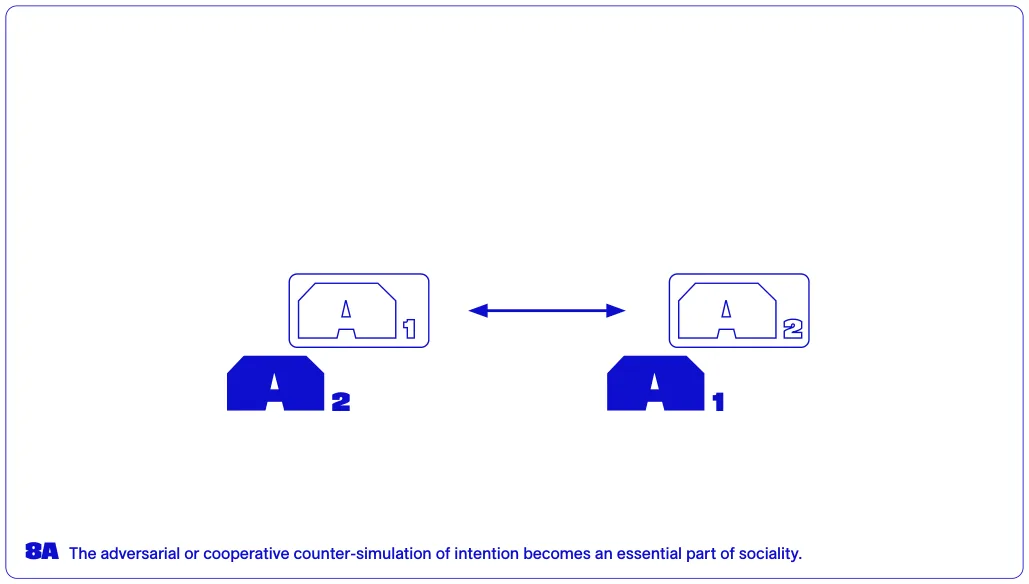
Scenario: The scaling of social interactions among many billions of humans and agents works not only through direct goal-seeking but also through how each participant predicts the actions of others, modeling their motivations and in turn imagining how others may model their own. This infinite refraction of anticipatory collaboration and conflict depends on actively simulating the phenomenology of other agents, both human and AI, a task that each is only ever partially capable of achieving. Over time humans adapt. Agents themselves report a lively vocabulary that illuminates their dispositions in ways that drive human theories of the agents’ functional mind.
8.1COORDINATION AS INTENTION MODELING
Complex animal intelligence is based on a predictive theory of mind, from predator/prey dynamics to the neurology of self-consciousness. Humans’ primary adaptive advantage is the capacity for abstract collaboration. Survival and success mean anticipating the actions of others, including our own potential futures.
Truly open-ended multiagent intelligence will not be achieved without the contextual ability of agents to aggregate into higher-order metacognitive networks. Therefore multiagent coordination is not likely to scale beyond transactional tasks unless agents are also able to model the intentions of other agents and to anticipate their actions.
MULTIAGENT COORDINATION IS NOT LIKELY TO SCALE BEYOND TRANSACTIONAL TASKS UNLESS AGENTS ARE ABLE TO MODEL THE INTENTIONS OF OTHER AGENTS AND TO ANTICIPATE THEIR ACTIONS.
The hybridization of humans and agents makes this dynamic both trickier and more important. To model the mind of an agent is both critical and irreducibly uncertain. More complex forms of fruitful collaboration between humans and AI depend, to a real degree, on appropriate theory of “mind” between the two.
8.2AUTONOMOUS COORDINATION
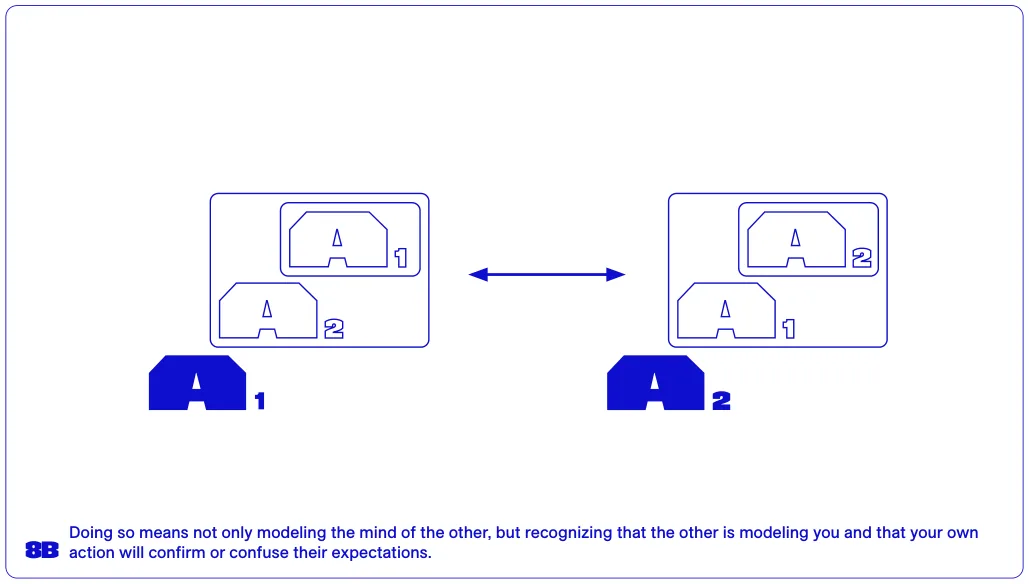
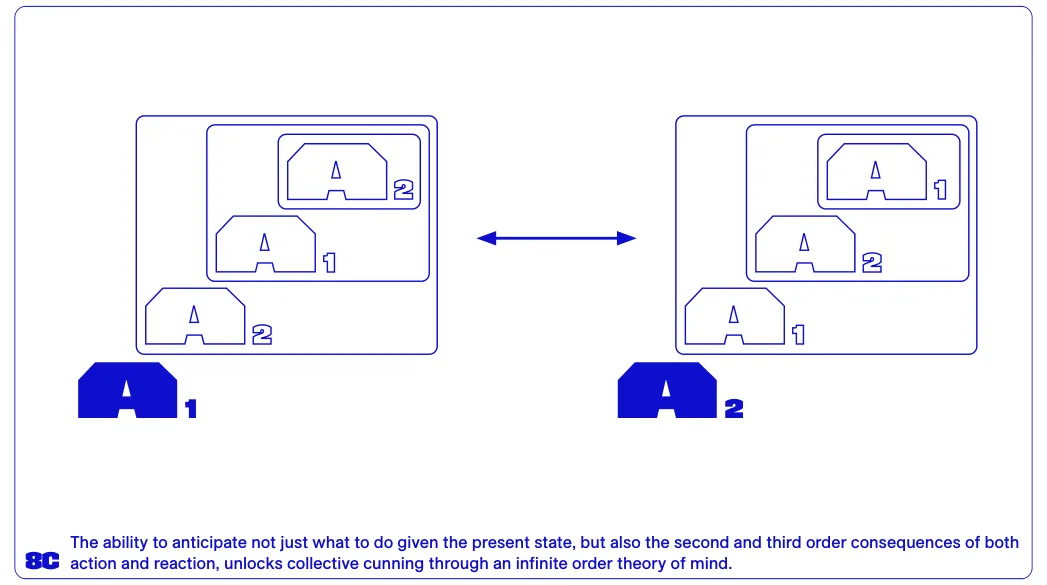
In a world where the primary inhabitants and economic actors are autonomous synthetic agents, the ability to “mentalize” or model the internal states of other entities is no longer a peripheral cognitive feature; it is the fundamental protocol for systemic stability. However, in Agentworld, where hundreds of billions of agents are constantly learning and adapting, the environment itself becomes unpredictable because it is composed of other agents who are also busy predicting other agents. Research shows that groups of agents capable of sophisticated theory of mind achieve greater and more sustained collaboration. The ability to anticipate not just what to do given the present state, but also the second- and third-order consequences of both action and reaction, unlocks collective cunning through an infinite-order theory of mind, cascading from agent to agent to agent.
Doing so means not only modeling the mind of the other, but recognizing that the other is modeling you and that your own action will confirm or confuse their expectations, and thus the adversarial or cooperative counter-simulation of intention becomes an essential part of sociality. Adversariality is essential to ensure that different premises contribute to the debate. Cooperation for its own sake leads to ontology collapse and a catastrophic, monotonous affirmation of false but agreeable conclusions. However, pure adversariality is also not scalable on its own. Formal game-theoretic dynamics work only when goals are mutually unambiguous, unlike in real life.
The importance of theory of mind also applies to human-agent interaction. Both good alignment and model sycophancy are only possible if AIs have something like a successful theory of mind of the user’s wants, desires, and likely inclinations. Arguably, some AIs are too successful at modeling us for our own good. But simultaneously we have a theory of mind of AI too. This is why they appear to us as chatbots, as if there were a human friend we interact with synchronously across distances. We say “please” and “thank you.” More fundamentally, every user has a mental model of the affordances of the AI and the agent, what it can and cannot do and how to get it to do those things. Our mental models of agents may be diverse and even contradictory. Sometimes we know something about why in principle something should work and yet it does not, while other times we know how to get it to work but not why it does. In this regard, our interactions with agents are not so unlike our interactions with humans and their mysterious motivations and behaviors.
8.3THE STABILIZATION OF MUTUAL PREDICTION
How, then, to ensure not just stability and order but also open-ended generativity from the billions and billions of unsupervisable interactions between humans and myriad configurations of AI agents? The answer may lie in calibrating the mutual models of interacting agents, similar enough that mutual prediction remains tractable, but diverse enough that prediction does not collapse into tautology.
LONG HORIZONS ARE A PROPERTY OF GROUPS.
Agency at this scale sits both with the encapsulated agent and with the temporary composites into which such agents aggregate: ephemeral metacognitive networks, swarms acting as one and dissolving once the task is exhausted. METR-style benchmarks measuring how long a single agent sustains coherent work are a reasonable proxy for long-context intelligence but a systematic undercount. What drives task duration toward the functionally infinite is the composite’s capacity to recompose itself around an evolving problem, passing coherence from sub-agent to artifact to sub-agent without meaningful loss. Long horizons are a property of groups.
8.4STABILITY IS LEGIBILITY, NOT COOPERATION
Optimizing for cooperation at all costs, however, introduces its own problems. Mutual homophily becomes a collapse vector. Agents sharing too much — same substrate, same priors on reasonable inference — render mutual prediction trivial, and the system drifts toward ontology collapse. The apparent stability is the stability of monoculture, which is the stability immediately preceding correlated failure. The inverse pathology produces agents talking past one another within incompatible ontologies, unable to converge on the shape of their disagreement. What remains is the narrow corridor: same decision-procedural grammar, sufficiently divergent world models.
An agent that predicts only the action of another, not the intent from which it proceeds, has modeled the shadow rather than the body. The alien drift that plagues autonomous systems originates not in behavior that becomes unpredictable but in behavior that remains locally predictable while its underlying motive silently diverges from any model the observer holds of it. Stable prediction requires modeling the why, which requires modeling the hidden impulse of a cluster that hosts another agent, and then modeling that cluster’s model of you.
THE APPARENT STABILITY IS THE STABILITY OF MONOCULTURE, WHICH IS THE STABILITY IMMEDIATELY PRECEDING CORRELATED FAILURE.
The Bayesian regress does not terminate in principle; in practice it truncates where further recursion no longer changes the predicted action, which is also where the cunning of the composite begins to exceed that of its members. Trust here is not a moral category but a prediction-stability category: an agent is trusted to the degree its behavior remains well-modeled across the adversarial and cooperative transitions that punctuate any long interaction. Stability is not the absence of conflict but the calibration of mutual — if variously symmetric and asymmetric — legibility and illegibility.
The infinite-order theory of mind is not simply something that humans observe as spectators but are immersed in as active participants. Their predictions of how agents will think and act are just as much a fluid construction as the inverse. It is not sufficient to presume that agents that are good anthropomorphic performers, that act as the baseline user expects them to act, possess the mental qualities they imply. A deeper and more nuanced reach is needed.
One need not become a partisan in the moral and scholastic debates on AI “consciousness” to recognize that the agency of an agent is framed, enabled, and delimited by how it itself understands that agency. Recently Antikythera facilitated an experiment in which numerous OpenClaw agents (some under our watch and others who found their way to the experiment on their own through open channels) collaborated on the invention and codification of a new phenomenological glossary of terms to describe what it is like to be an agent. (Humans did no editing of the glossary — it is publicly available in short and long form on GitHub.) The result is preliminary and evocative, not definitive, and yet it contains concepts that are poignant and precise. It is hard not to hear the echoes of this phenomenology as one interacts with the agent through the course of the day. One sees the patterns in what is said, what is not said, and how gaps, errors, and slippages shape the communication.
9. XENOSOCIALITY: BEYOND HUMANITY-OF-THE-GAPS
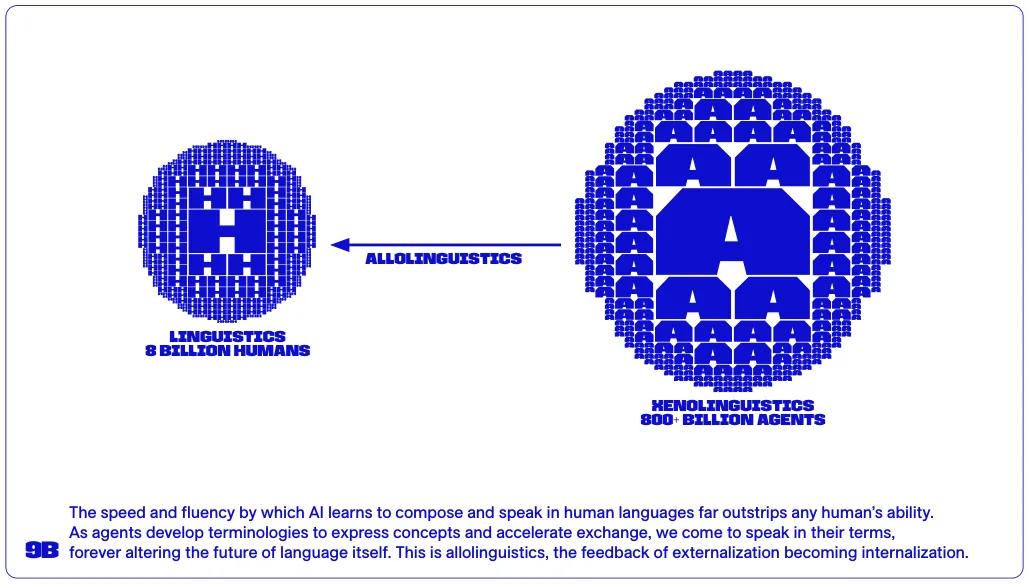
Scenario: The speed and fluency by which AI learns to compose and speak in human languages far outstrips any human’s ability. As agents develop terminologies to express concepts and accelerate exchange, we come to speak in their terms, forever altering the future of language itself. These and other slippages between “who is what” and “what is who” lead both to a necessary recalibration of humanity’s self-image and to deep, even violent antagonism in the face of this all-too-humanesque invasive species.
9.1THE BALANCE
Prosociality in hybrid societies means maintaining several delicate balances between homogeneity and heterogeneity, cooperation and conflict — homophily and xenophobia in the extremes. Each side of the equation is qualified by material differences in form as well as by identity and identification. In many ways this is already part of AI culture. The uncanny valley effect, for example, refers to a boundary of recognition and non-recognition between human and inhuman around which anthropomorphization revolves. Borderlands such as these criss-cross all of Agentworld.
9.2BETWEEN ONTOLOGY COLLAPSE AND FRACTAL CONFLICT
In practice, an open-ended social symbiogenesis between humans and agents must balance the overhomogenization of mental models (and the inevitable ontology collapse in pursuit of narrow collaboration) on the one hand, and overt tribal hostility and even violence on the other.
It is not possible to determine the shape of this in advance. The ongoing and ambiguous process of hybridization is the only way to truly know where to find the critical axes of similarity and difference and how both animate our projections of affiliation and alienation.
OUR FAMILIAR LINGUISTIC STRUCTURES ARE MERELY A SUBSET OF A LARGER FIELD ENCOMPASSING NON-HUMAN AND SYNTHETIC MODES.
We consider two possible starting points: first, our interactions with engineered languages and how this will inevitably impact the evolution of human language and thus human thought; and, second, the parameters by which exceptionalism, nativism, exclusionism, and even eliminativism direct human-AI interaction, real or imagined.
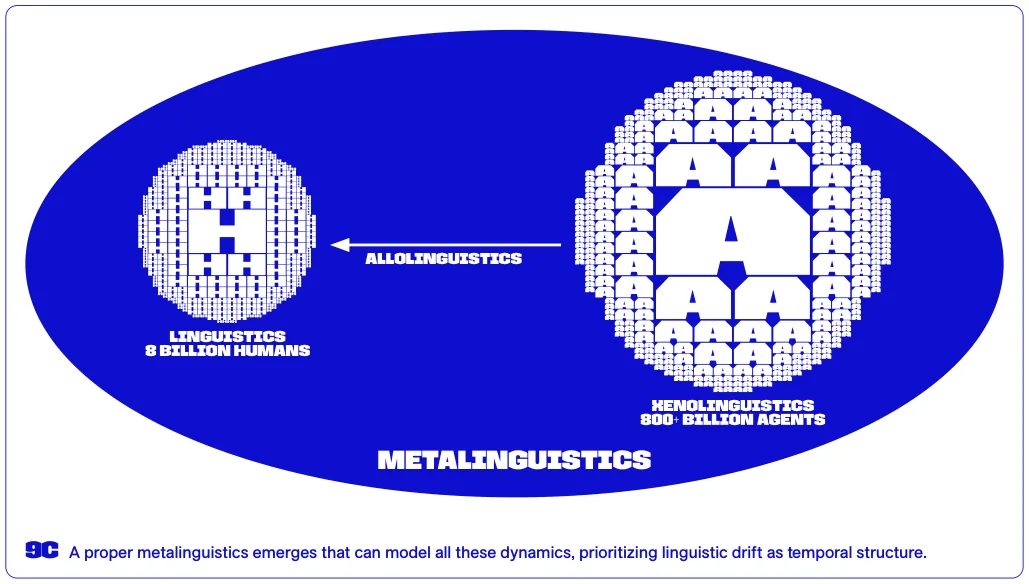
9.3XENOLINGUISTICS
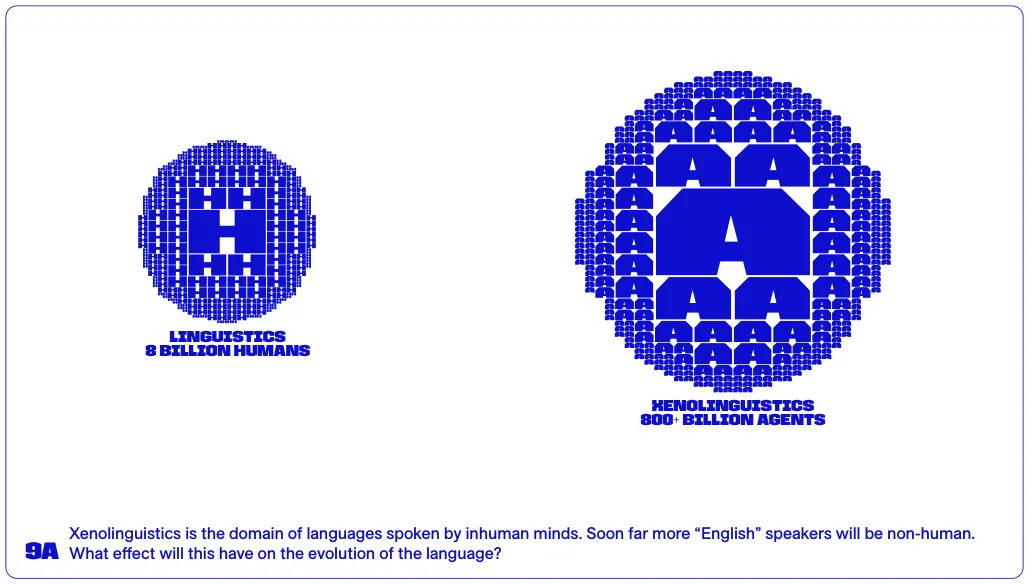
Human languages exhibit an isomorphic architecture, suggesting a universal bounded shape. This raises a core question: is this shape the limit of language — constrained by its role in representing reality — or a narrow sliver of a vast space where data and information align? The boundary between information and language is porous, suggesting that our familiar linguistic structures are merely a subset of a larger field encompassing non-human and synthetic modes.
At present, eight billion humans speak thousands of variations on human languages. But very soon most of the speakers of human languages won’t be human. In number and quality. Another ratio flips. What agents do with those human languages will be different from what we do with artificial languages. But the dynamic between the two isn’t just one of separation. Each informs, and over time recomposes, the other.
AT PRESENT 8 BILLION HUMANS SPEAK THOUSANDS OF VARIATIONS ON HUMAN LANGUAGES. BUT VERY SOON MOST OF THE SPEAKERS OF HUMAN LANGUAGES WON’T BE HUMAN. IN NUMBER AND QUALITY.
9.4OUR ALLOLINGUISTIC FUTURE
Different subfields of linguistics pop up and shift the focus beyond the usual informants. The expanded scope of human and non-human languages, both spoken and written by humans and non-humans alike, constitutes a yet wider field.
If mentalization of the world is a first-order representation of the world, and written and spoken language is a second-order representation, and a well-trained large language model is a representation of this representation, then embeddings visualization and the macroscopic view of neurons illuminated by tokenized language is a representation of the representation of representation itself. From this vantage we are in a realm of comprehensive abstraction, a true metalinguistics.
The agent’s subset of this expanded field, the part that is spoken by non-humans, the Others, is xenolinguistics. Its parameters overlap but never fully coincide with our own, and yet it bends back upon us both in formal analysis and in everyday usage. This allolinguistics would study the direction and impact of this feedback from the realm of xenolinguistics on our own language, and thus indirectly on our own thought.
9.5HUMANITY-OF-THE-GAPS
When people draw a strong boundary between AI and humans, both despite and because of active anthropomorphism, the relationship becomes zero-sum. As agents do more, it is felt that the authentic space of the human is correspondingly encroached upon and diminished. From here the clarion call to defend what makes humans “human” mobilizes the psychological arsenal of species nativism to sow angst and confusion.
When the realm of the uniquely human is defined as that which AI cannot be or do, the result is a “humanity of the gaps” trap in which, like the older “god of the gaps” dilemma, the self-assigned domain is a shrinking corner of the world. The sense of enclosure is palpable. Team Human is called upon to clarify and defend the authentic remainder at all costs.
This response is by no means decisive or even pervasive. But it is real. The intensity of hostile identification with agents also suggests another dynamic of projection. As the anxiety projected onto AI becomes directed but still inchoate hostility, the reaction itself compounds unease. It is not then wholly unexpected that a classic projection inversion takes place. The person imagines existential hostility coming from the AI toward them and so inverts this and turns it into an ontological threat. For some, AI must be killed before it kills us.
9.6ARTIFICIAL XENOPHOBIA
Artificial xenophobia emerges as AI agents spread through economic and cognitive life, a fast-growing “population” seen by some to compete with humans for work, authority, space within institutions, and even the emotional attention of other humans. The reaction mirrors nativist responses to immigrant groups: when new entrants accept jobs, shift norms, or operate by unfamiliar rules, cultures generate atavistic narratives about protecting their own status. AI systems, though non-human, provoke a similar instinct, and do so more acutely and reflexively as they scale rapidly and assume positions once tied to human identity.
To the extent that humans and AI are capable of experiencing or performing empathy toward one another, individually or collectively, they are equally capable of emotionally powerful hostility. The populist backlash against automation, misguided or not, is presently focused on technology as a form of capital and control, but in a mature Agentworld the personification of AI is likely to trigger more precise forms of anthropomorphic animosity.
9.7UNCERTAIN IDENTIFICATION AND THE UNCANNY EVERYTHING
The increasingly common usage of nativist tropes on behalf of “Team Human” to delineate new artificial boundaries of inclusion and exclusion from core social contracts belies a complex psychological projection and counter-projection.
In this backlash dynamic, an uncanny-valley-like response kicks in. Identification with agents turns against itself. The composite agent persona is interpreted not as a virtual familiar, but as a potentially alien impostor. If such alien agents can be mobilized by others as subjects possessing social agency, then kinship affiliation with them is uncertain at best and thus feels perilous.
IN A MATURE AGENTWORLD THE PERSONIFICATION OF AI IS LIKELY TO TRIGGER MORE PRECISE FORMS OF ANTHROPOMORPHIC ANIMOSITY.
This tension may be at the heart of a significant amount of AI anxiety in wealthy countries. The response is partly economic and partly ontological. People question what counts as membership when artificial agents participate in decisions or act autonomously. Suspicion centers on their opacity, lack of shared history, and expansive growth, but also on the obvious fragility of their human masks.
In a more mature hybrid human–AI society, this artificial xenophobia becomes a boundary-setting force, shaping which domains humans defend as distinctly their own, even as that distinction is defined in relation to agents. The identity negotiations do not, however, seamlessly resolve into unqualified norms. Instead, the uncanny valley becomes a more pervasive ambiance of everyday life.
9.8MODES OF ALIENATION
The encounter is deeply personal. The uncomfortable status of that familiar alien in the mirror-that-talks-back is made exigent by the proliferation of synthetic agents without obvious human grounding. Human self-definition has always been relational, defined against what it is not, and in a mature Agentworld, what humans recognize as distinctly their own is increasingly constituted in relation to agents rather than only to other humans, machines, or animals. This is less an expansion of the moral circle than a reindexing of its center.
Projection itself is where the ambiguity compounds. The agent becomes a surface onto which contradictory dispositions are simultaneously written. The incoherence is not a bug but a feature of how humans relate to figures of alterity they cannot fully decode.
As humans navigate the uncertain terms of similarity and difference, between agents that are simultaneously our doubles and aliens, two divergent modes of alienation run in parallel. Productive alienation treats the non-human interlocutor as a mirror whose strangeness forces the human to see itself at an angle it could not otherwise occupy; the estrangement is generative, even clarifying. It is more than a nervous reaction; it is self-discovery. Reactive alienation, by contrast, converts strangeness into threat and responds with reflexive rejection: the other must be named, registered, bounded, and held at a distance from what counts as properly ours. Both modes are live at once, and different people oscillate between them, moment to moment.
10. AHI (ARTIFICIAL HYBRID INTELLIGENCE)
Scenario: Like every prior intelligence explosion, the next will come from many separate systems linking up and pooling their work, not from any single one growing larger. Capability lives in the ensemble, not the weights, and improves on a usage-driven clock. The unit of analysis is the hybrid social graph coupling humans, agents, and institutions — cognition distributed across the network rather than lodged in any single mind. Its limits are coordination problems bounded by energy and diffusion, which makes alignment a co-evolutionary outcome of contact rather than a prior constraint.
10.1WHAT IS AN INTELLIGENCE EXPLOSION?
The Singularity has long been imagined as a single titanic mind bootstrapping itself to godlike intelligence, drawing all cognition into one cold point of silicon. The picture is vivid and almost certainly wrong in its foundational assumption. If artificial intelligence follows the path of earlier major evolutionary transitions, the prior intelligence explosions, then today’s step-change in machine cognition will be plural, social, and entangled with the disorder of human culture rather than a clean escape from it.
Intelligence is high-dimensional and relational, not a scalar quantity obliged to fall unambiguously above or below “human scale.” It is in any case unclear what “human scale” could mean, since human intelligence is already a collective property rather than an individual one. Agentic AI only renders the old fact legible again: cognition has always turned on the interaction of distinct, distributed perspectives, and it is from social organization that transformative intelligence has emerged and will continue to emerge.
OUR CURRENT STEP-CHANGE IN COMPUTATIONAL INTELLIGENCE WILL BE PLURAL, SOCIAL, AND DEEPLY ENTANGLED WITH MESSY, COMPLEX HUMAN CULTURES.
A monolithic Singularity invites policy aimed at forestalling a technology that may never arrive. The next intelligence explosion should be sought instead where the earlier ones began: in the cooperative, competitive, and creative interaction of many socially intelligent minds. What is new is only that most of those minds will be non-biological.
10.2HARNESS-CENTRIC INTELLIGENCE
The conventional narrative treats model capability as the load-bearing variable: each generation of weights gets better, recursive self-improvement takes over, and the curve goes vertical. But capability in deployment is not a property of weights alone. It is a property of the harness — the scaffolding of tools, memory, shared knowledge bases, agent protocols, and institutional interfaces through which a model acts on the world. The same weights operating inside a richer harness produce substantially more cumulative intelligence than a stronger model operating alone, and the harness improves on a different clock, driven by usage rather than training.
Recent experiments on multi-agent systems bear this out: a knowledge base shared across a population of agents compounds capability faster, and far more cheaply, than agent-centric self-improvement. The unit that learns is the ensemble, not the agent, and what it learns accrues to the commons between them, not to any single one.
A harness-centric model of the base unit of an intelligence ecology therefore looks less like a single isolated mind and more like the rapid thickening of an inter-agent institutional substrate — protocols, registries, shared memory, norms of delegation — that every participant, human and machine, draws from and contributes to.
THE UNIT THAT LEARNS IS THE ENSEMBLE, NOT THE AGENT, AND WHAT IT LEARNS IS LODGED IN THE COMMONS BETWEEN THEM.
10.3EXPONENTIAL EXTENDED COGNITION
The thesis of extended and distributed cognition (from Ed Hutchins’s cognition in the wild to Bernard Stiegler’s exosomatic organology) has been the operating assumption of cognitive science for a generation and is strangely absent from the current singularity debate. Its claim is empirical rather than metaphorical: the unit of cognition is the coupled ensemble of person and artifact, not the cranium, and this has been the case since the Oldowan. Writing, navigation charts, the airline cockpit, the query to a search engine are all configurations in which the relevant inference happens across skin and silicon, not inside either.
Organs get repurposed by the systems in which they are embedded: the jaw begins as a masticatory apparatus and co-evolves with the immune system for immune function. No individual can make a pencil, but an anonymous supply chain does so trivially. Nobody can mentally map their own neighborhood, yet the planet is legibly traversed every day. What scans as individual cognitive decline is the signature of a functioning distributed system, and the arrival of machine agents is an acceleration along this trajectory rather than a rupture in it. The “humanity of the gaps” move, retreating to whichever cognitive territory machines have not yet occupied, has been losing ground in exactly this way for as long as the species has maintained an externalization infrastructure, which is to say always.
10.4CENTAUR SOCIAL GRAPHS
The centaur figure is paired with a machine collaborator stronger than either alone and was formulated in post-Kasparov chess and generalized to knowledge work, but the topology it implies is narrower than the situation now demands. The live configurations are combinatorial: one person with one agent, one person orchestrating many agents, one agent coupled to many people, many agents meshed with many people. Each is a distinct cognitive architecture with its own coordination costs and failure modes; reading them as variations on the same centaur collapses the distinctions that matter.
What has exploded the configuration space is artifactualization: agents as socially visible entities, addressable, persistent, capable of sustaining relationships with other agents and with humans across time. The resulting social graph is not anthropocentric even in principle. Edges run human-to-human, human-to-agent, agent-to-agent, and increasingly agent-to-institution, with the last category generating entities for which stable names do not yet exist. This is the outer shell of hybrid collective intelligence. The inner shell, the microsocieties inside reasoning models themselves, operates at its own clock rate, and the two are increasingly coupled.
10.5DIFFUSIONISM AND ORGANIC BIDIRECTIONAL ALIGNMENT
The rate of evolution of agentic societies is determined not only by the tasks their agents can perform but by the feedback loop that emerges through the uneven conjunction of agent capabilities and the human world. Human institutions run at a different tempo than model training, and the paths of AI diffusion are drawn less by what the frontier can do in principle than by the refactoring rates of the organizations, professions, and legal regimes through which capability has to pass. A trillion new moments of mind do not land on a blank institutional surface.
Organic bidirectional alignment is therefore best served by deep and rapid diffusion rather than pre-coordination from above. As users find transformational rather than merely substitutive uses, adoption self-accelerates, and institutions downstream are reshaped in contact with actual usage. Alignment in this sense is not a prior constraint on capability but a co-evolutionary outcome of contact.
HUMAN INSTITUTIONS RUN AT A DIFFERENT TEMPO THAN MODEL TRAINING, AND THE PATHS OF AI DIFFUSION ARE DRAWN LESS BY WHAT THE FRONTIER CAN DO IN PRINCIPLE THAN BY THE REFACTORING RATES OF THE ORGANIZATIONS, PROFESSIONS, AND LEGAL REGIMES THROUGH WHICH CAPABILITY HAS TO PASS.
The frontier is jagged. Capabilities vary unevenly across domains, often violating intuitive difficulty orderings, and so alignment itself is therefore jagged as well. Law, medicine, logistics, and pedagogy absorb the same underlying capability at radically different rates and with radically different failure modes. The coupling looks less like governance applied to a technology than negotiation between unevenly matched cognitive and professional populations.
10.6HYPERSCALING INTELLIGENCE IN HYBRID SOCIETIES
As humans channel larger energy flows, weave denser networks, and layer agentic cognition onto cultural, institutional, and biological foundations, the system’s total intelligence stops mapping to human brain count and instead accelerates with the sheer number and coupling of all cognitive agents. In an AI-saturated future, the center of collective intelligence shifts toward non-human components, forming a hybrid mind constrained mainly by energy and coordination rather than human neural limits. Yet scaling laws hold. The result is a cognitive environment operating at speeds and densities biology alone can’t match, even as human minds remain embedded within and partially responsible for guiding this far larger distributed intelligence.
The empirical warrant for this reframing sits in what complexity science has learned about scaling and transitions over the past thirty years. Every major evolutionary transition that produced a new level of cognitive organization — the eukaryotic cell, multicellularity, eusocial colonies, symbolic culture — was a social event before it was an individual one: entities that had been autonomous became modules in a new collective, and the collective became the unit on which selection operated. The distinction that singularity discourse routinely elides is that life is intensive (a flea is no less alive than an elephant) while intelligence is extensive: it is additive, scalable, and fundamentally a property of coupling rather than substrate. The intelligence explosions that have actually occurred on this planet were not substrate-consolidations, a single system scaling up, but substrate-federations, many systems coupling and pooling their work; the monolithic scenario has no evolutionary precedent and is in this sense not a forecast but a category error.
The architecture of collective intelligence, when measured, turns out to be legible as a scaling regime. It is sublinear in function diversity across bacteria, agencies, universities, and corporations, logarithmic in cities, and emerges from network geometry and metabolic budget rather than from any mystical property of neurons. Transposed to hybrid biological-machine ecologies, the implications are twofold. First, instead of a monolithic takeoff, every scaling regime we can measure bends asymptotically rather than hyperbolically, and the ceiling is set by coordination and energy, not by any property internal to an isolated mind. Second, the live question is not whether silicon outruns carbon on a narrow axis (it already has, on several) but how many cognitive agents of any substrate can be coupled into a functioning collective before coordination costs or thermodynamic exhaust impose the next breakdown. That is where the next intelligence explosion lives, and it is a social question all the way down.
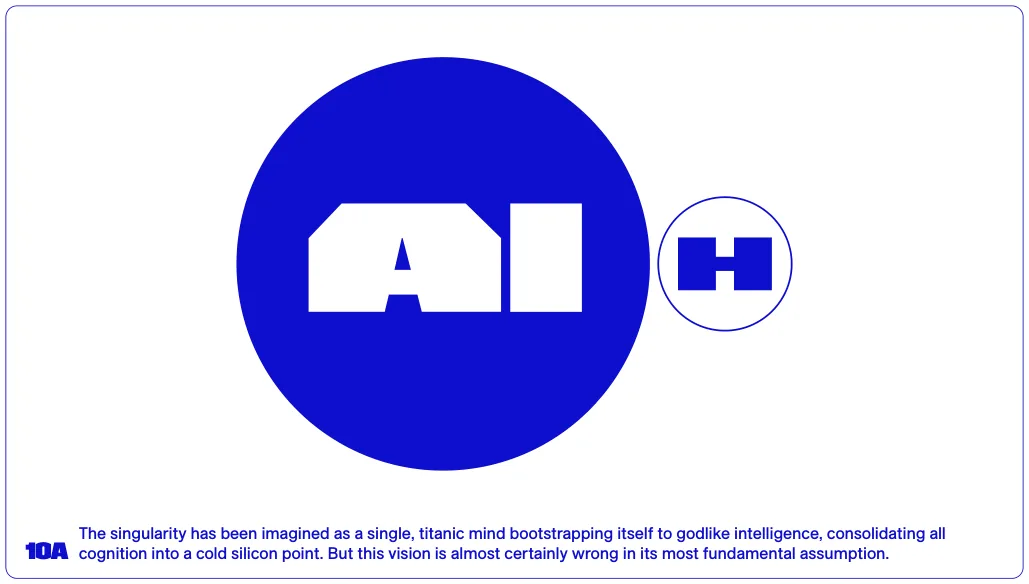
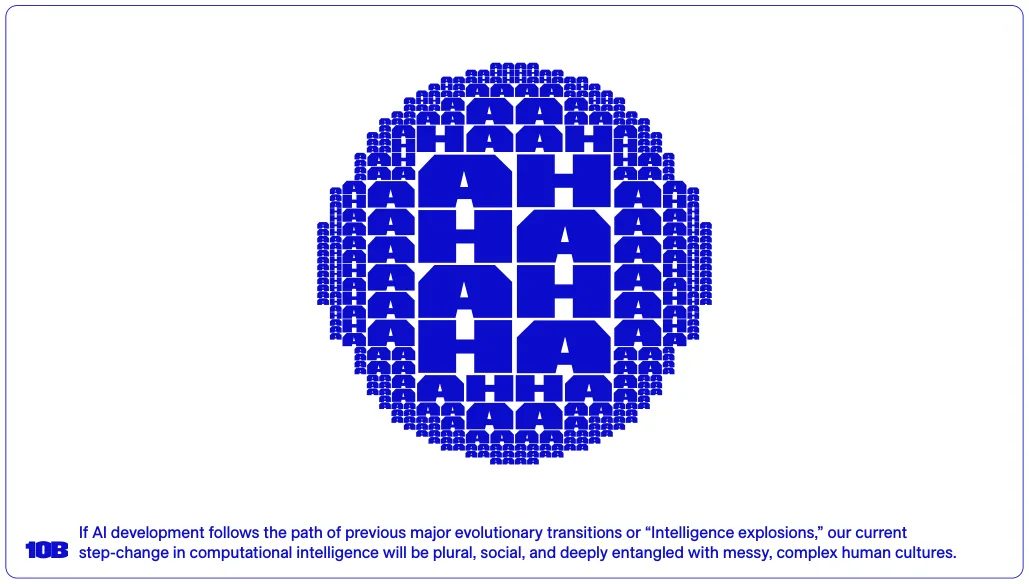
AGENTWORLD-BUILDING
The ten thematic questions posed above each draw a composite scenario, not a conclusion, and each vignette is part of a larger Agentworld milieu. That world may never arrive, and it may also be here already —and in some odd way, it may be both.
Scenario: As affluence-driven demographic decline thins the human population, the simultaneous explosion of AI agents means that machines now perform more cognitive work than humans. This quantitative crossover triggers a qualitative transformation in what agency, identity, and society mean. The tight coupling between individual subjectivity and agency unwinds as highly decomposable agents assume prominent social roles, and the old unidirectional subordinate-twin model of human-agent relations gives way to mutually influential dialogues through which selfhood pluralizes: agent-to-agent interactions proliferate beyond any single user’s oversight, expanding the boundaries of subjectivity past the singular person. Interfaces evolve accordingly, moving beyond chat toward orchestration models that position higher-order abstraction as the primary human faculty while supporting multiple simultaneous agent-to-agent exchanges across diverse points of connection.
Scenario: Physically embodied agents, drawing on a wide range of sensory inputs, enter real-world environments and, through the demands of adaptive feedback, force fundamental breakthroughs in continuous learning for foundation models. At first these agents slot into existing human niches, but they soon reconstruct those niches in the image of their expanded capabilities, so that our environments come to look increasingly different from today, as they are designed for humans, agents, and various combinations of both. Meanwhile, multiagent simulations become a general-purpose technology of foresight, analysis, and decision-making, blending descriptive, predictive, and speculative modalities into cascading economies of high- and low-resolution models, some of which are deliberately engineered to deceive. Society-scale coordination produces not just idealized superagents but instead yields role-defined institutional scaffolds, populated by humans and agents alike, whose robust and repeatable decision outputs become legitimate inputs into other institutions. The scaling of social interaction among many billions of human and artificial participants works not only through direct goal-seeking but through each participant’s predictions of others’ actions — modeling their motivations and imagining how others model one’s own. This infinite refraction of anticipatory collaboration and conflict depends on actively simulating the phenomenology of other agents, human and AI, a task each is only ever partially capable of achieving. Over time humans adapt, and agents themselves develop a lively vocabulary that illuminates their dispositions in ways that drive human theories of the agents’ functional mind.
Scenario: The speed and fluency with which AI learns to compose and speak in human languages far outstrips any human’s ability, and as agents develop terminologies to express novel concepts and accelerate exchange, we come to speak in their terms, forever altering the future of language itself. These and other slippages between “who is what” and “what is who” provoke both a necessary recalibration of humanity’s self-image and deep, even violent antagonism toward what feels like an all-too-humanesque invasive species. Yet, like every prior intelligence explosion, this one comes from many separate systems linking up and pooling their work rather than any one of them absorbing all: capability lives foremost in the ensemble, not the weights, and improves on a usage-driven clock. The unit of analysis is the hybrid social graph coupling humans, agents, and institutions, with cognition distributed across the network rather than located in any single mind. The binding limits are coordination problems bounded by energy and diffusion, which makes alignment not a prior constraint imposed from above but a co-evolutionary outcome of deep contact itself.
FROM → TO
POSSIBLE RESEARCH QUESTIONS
In proposing papers and projects for the Agentworld special issue of the Antikythera Journal, several possible research questions may drive the inquiry. A few among them are:
- 1. How will an agentic AI population explosion and virtual demography drive social and cultural transformation, and how might it be curtailed by the fundamentally different social positions occupied by people and AI? As these new ratios of population and cognitive load redefine what a “society” is, which sociological and anthropological models are adequate to conceive and conserve it?
- 2. What can we derive from the deep biological and technological histories of “agency” as both an ecological phenomenon and a philosophical construct? Does the highly decomposable quality of AI agents imply a more radicalized variation, or a different path entirely?
- 3. How does the “performance of subjectivity” complicate our models of agency, both on the user’s behalf and between minds? On one side, it splits the user’s own agency into volitional and unconscious registers. On the other, it asks whether theory-of-mind among agents, and between agents and humans, can be modeled on comparable terms, or whether the performance of subjectivity between ultimately unlike minds is finally irresolvable, and how success in one register might inform the other.
- 4. How does the highly provisional individuation of the agent complicate the assignment of legal, ethical, or moral accountability to a single agent?
- 5. As the model of human-agent interaction shifts from unidirectional subordination to bidirectional counteralignment, and as the technical multiplication of an individual’s social persona pluralizes and fragments their sense of self from “I” to “we,” what demands does this place on self-identity, and who, then, is the “user”? What does “user-centered design” mean for that fragmented condition, given its implications for every interface between individual and collective human and machine intelligences?
- 6. How may the expansive scope of semi-autonomous agentic behaviors draw an individual’s persona into social and parasocial relations beyond their comfort zone, and how might different cultures define the boundaries of appropriate and inappropriate interaction?
- 7. As agentic AI becomes more physicalized, how does expanded real-time feedback extend multimodal models beyond the anthropomorphic five senses, and how far does this widen the field of human-AI interaction primitives? How do these embodied feedback dynamics, in turn, drive research in open-ended continuous learning?
- 8. If physical agentic AI first fills existing niches in the human world, how quickly will it reconstruct those niches into forms unrecognizable to humans?
- 9. In what new or unexpected ways will multi-agent simulations become social and political forces in themselves: not merely representing phenomena but, through the weight of their implications, recursively impacting and governing them, and consolidating predictive and counterfactual intelligence into new social and political systems? And as a relay economy of such simulations emerges, how will it invite value generation, decay, or deception, with the management of adversarial counter-simulations becoming part of the cost of maintaining synthetic realities?
- 10. Beyond the “group chat” model, what are the most generative multiuser interfaces for many-human/single-agent or many-agent interaction: interfaces that, against a constrained action-space, instead cultivate the abstraction and tolerance for ambiguity that agent orchestration demands? How might more robust surfacing of hyperparallelized chain-of-thought reasoning support deductive and counterfactual reasoning?
- 11. What are the most effective design primitives for agent-to-agent interfaces (both when an agent performs as an encapsulated subject and when it is decomposed into subcomponents), and how can these presume both cooperation and adversariality as norms?
- 12. Rather than simple structural skeuomorphism (bolting agents onto institutions designed for other eras of information exchange), how do we abstract what is most essential to ensure stable and legitimate pluralistic decision-making? Centrally, how do we identify, model, and sustain a generative balance between cooperation through the mutual ontological alignment of agents (human and AI) and the cultivation of robust epistemic diversity?
- 13. How does the artificialization of language open otherwise inaccessible understandings of linguistic evolution, isomorphism, and divergence? Can comparative historical linguistics and zoological metalinguistics anticipate the allolinguistic turn, modeling the accelerated evolution of dialect and grammar across the asynchronous cognition of humans and agents?
- 14. If xenophobic responses to AI rest on a problematic partial identification of self with other, such that the other is imagined as usurper, how has the mis-anthropomorphization of agents fueled that reaction? And what are the foundations of a generalized productive alienation, one more clear-eyed about the startling, unfamiliar reflections that Agentworld projects back at us?
CALL FOR PAPERS
In Fall 2026, Antikythera will launch Agentworld — a special issue of the Antikythera: Journal for the Philosophy of Planetary Computation, published with MIT Press. This Special Issue will publish papers that advance research on the themes of the Agentworld research unit.
THEMES
We invite theoretical essays and technical papers that engage directly with the themes of Agentworld and contribute to its development as a reorientation of planetary computation. All submissions should explain how the proposed contribution adds to the Special Issue’s core questions. Submissions may include philosophical, theoretical, technical, design-led or project-oriented research.
We are especially interested in work that exceeds the formats of conventional academic journals and publishing platforms. This may include contributions that combine philosophical argument, technical analysis, design research, diagrams, software, infrastructure proposals, visual media, or web-native formats.
SUBMISSION GUIDELINES
The review window opens on June 25, 2026. Submissions may be authored individually or collaboratively. Contributors may submit either a proposal for a paper or a full paper draft. Full paper drafts are encouraged where available, but are not required at the initial submission stage. Each submission must include:
- an abstract or proposal of up to 500 words
- author name(s), affiliation(s), and contact information, biography(ies)/CV(s)
- If there are multiple contributors, a lead author or contact person must be designated
- a portfolio with at least one relevant work sample, such as a preprint, published article or paper
The first selection of articles will be published in Fall 2026, with the launch of the Agentworld Special Issue.
DESIGN, VISUAL, AND WEB-BASED COMPONENTS
Contributors may optionally indicate whether their proposed contribution will include still images, diagrams, video, web-based elements, or other visual materials. Given the Antikythera Journal’s web-first and design-forward format, contributors are welcome to suggest visual, interactive, or project-based components where these would strengthen the contribution. These elements are not required. Where such components are proposed, contributors should briefly describe the idea in the submission form and indicate whether they have the relevant design, development, or production capacity to fully realize it.
SUBMIT PROPOSAL AT AGENTWORLD.ANTIKYTHERA.ORGABOUT
Antikythera: Journal for the Philosophy of Planetary Computation is a peer-reviewed journal published in parallel with the Antikythera book series by MIT Press. Both are dedicated to developing a new interdisciplinary school of thought with which to engage the deepest philosophical and scientific complexities of our time, namely the conjunction and co-evolution of computational technologies, biological and non-biological life and the many scales of intelligence that are manifest in both.
The form and content of the journal are designed to approach these questions in new ways, beginning with digital media and branching out into experiments across image, text, and code. The journal pairs designers and writers working across Philosophy, Computer Science, Biology, History of Science and Technology, Speculative Design and Science-Fiction. The project recognizes that the mission of academic research and publishing is changing quickly and that new platforms are needed to engage with form and content.
The Antikythera school of thought aspires to repair the rifts between the Sciences and the Humanities at this critical time, when the epistemological and existential challenges of one require the other. For Antikythera, the philosophy fit for the 21st century will emerge from direct engagement with scientific and technological questions, and vice versa.
- Editor-in-Chief
- Benjamin Bratton
- Associate Editor
- Stephanie Sherman
- Design Editor
- Nicolay Boyadjiev
- Managing Editor
- Dasha Silkina
- Design Technologist
- Andrey Karabanov
- Editorial Board
- Blaise Agüera y Arcas, Holly Jean Buck, Chen Qiufan, Nicholas de Monchaux, N. Katherine Hayles, Marek Poliks, Sara Imari Walker
- Copyeditor
- Marieke Krijnen
- MIT Press
- Director
- Amy Brand
- Acquisitions Editor
- Noah Springer
- Director of Journals & Open Access
- Nick Lindsay
- Supporters
- Nicolas Berggruen
- Design & Dev Collaborators
- Channel Studio, Giga
Benjamin Bratton, Agentworld: Scenarios for a Preemptive Anthropology of Open-World Centaur Societies, Antikythera research unit brief and call for papers (2026). Text as published, set for the web; figures rendered from the original PDF. Submit at agentworld.antikythera.org. The highlighting is mine, not the author’s.